Water → tert-Butyl 6-bromoindoline-1-carboxylate
Reaction equation

[C:1](=[O:12])([O:7][C:8]([CH3:11])([CH3:10])[CH3:9])OC(C)(C)C.[Br:13][C:14]1[CH:22]=[C:21]2[C:17]([CH2:18][CH2:19][NH:20]2)=[CH:16][CH:15]=1.C(N(CC)CC)C.O>O1CCCC1.C(OCC)(=O)C>[C:8]([O:7][C:1]([N:20]1[C:21]2[C:17](=[CH:16][CH:15]=[C:14]([Br:13])[CH:22]=2)[CH2:18][CH2:19]1)=[O:12])([CH3:9])([CH3:10])[CH3:11]Participants
7
Reactant 4



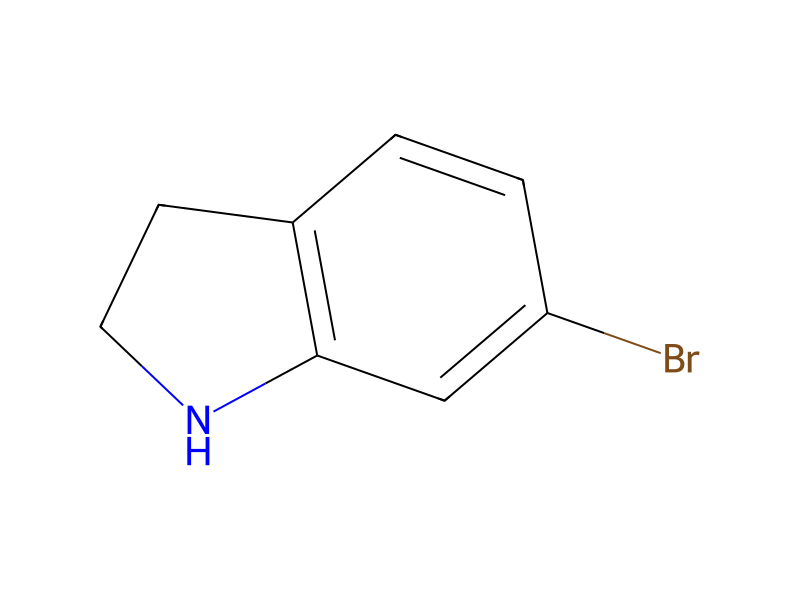
Product 1

Reagents, catalysts & solvents 2


Procedure
Di-t-butyl carbonate (6.7 g) was added to a solution of 6-bromoindoline (5.1 g) and triethylamine (3.1 g) in tetrahydrofuran (50 ml) followed by stirring the resultant mixture at room temperature overnight. After adding water and ethyl acetate thereto, the layers were separated and the organic layer was washed with brine and dried over anhydrous magnesium sulfate. The residue was then purified by silica gel column chromatography (hexane/ethyl acetate system) to give the title compound (5.5 g) as a colorless oil (yield: 71%).
Workup
- customthe layers were separated
- washthe organic layer was washed with brine
- dry with materialdried over anhydrous magnesium sulfate
- customThe residue was then purified by silica gel column chromatography (hexane/ethyl acetate system)
Sources & evidence
- ORD record
- ord-addcacbb6213493293811ebb667a59e9
- Source dataset
- uspto-grants-2006_07
- Patent number
- US07071201B2
Reaction notes
Loading…