4-Nitrophenol → 2-((4-Nitrophenoxy)methyl)oxirane
Reaction equation

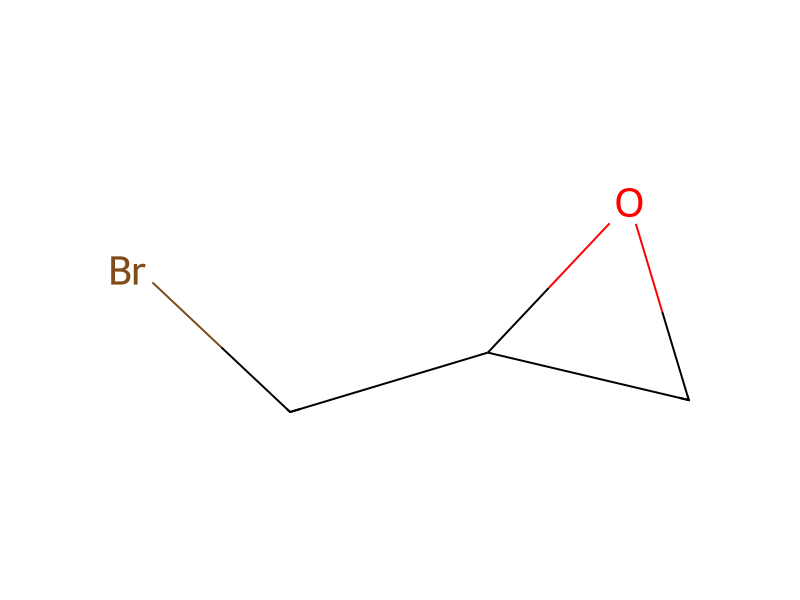
[N+:1]([C:4]1[CH:9]=[CH:8][C:7]([OH:10])=[CH:6][CH:5]=1)([O-:3])=[O:2].C(=O)([O-])[O-].[K+].[K+].[CH2:17]([CH:19]1[O:21][CH2:20]1)Br>[Br-].C([N+](CCCC)(CCCC)CCCC)CCC.C(OCC)(=O)C>[N+:1]([C:4]1[CH:9]=[CH:8][C:7]([O:10][CH2:17][CH:19]2[O:21][CH2:20]2)=[CH:6][CH:5]=1)([O-:3])=[O:2]Participants
Reactant 3


Product 1

Reagents, catalysts & solvents 2


Conditions
- Temperature
- 100 °C
Procedure
1-(4-Nitrophenoxy)-2,3-epoxypropane was prepared by an analogous method to that described by Zhen-Zhong Lui et. al. in Synthetic Communications (1994), 24, 833–838. 4-Nitrophenol (4.0 g), anhydrous potassium carbonate (8.0 g) and tetrabutylammonium bromide (0.4 g) were mixed with epibromohydrin (10 ml). The reaction mixture was heated at 100° C. for 1 hour. After cooling to ambient temperature, the reaction mixture was diluted with ethyl acetate and filtered. The filtrate was evaporated to dryness and the residue was codistilled twice with toluene. The resulting oil was purified by column chromatography and eluted with ethanol (1.0%):dichloromethane to yield on evaporation an oil that crystallised (4.36 g, 77.7% yield). NMR (CDCl3): 2.78 (m, 1H), 2.95 (m, 1H), 3.38 (m, 1H), 4.02 (dd, 1H), 4.38 (dd, 1H), 7.00 (d, 2H), 8.20 (d, 2H); m/z 196 [MH]+.
Workup
- temperatureAfter cooling to ambient temperature
- filtrationfiltered
- customThe filtrate was evaporated to dryness
- customThe resulting oil was purified by column chromatography
- washeluted with ethanol (1.0%)
- customdichloromethane to yield on evaporation an oil that
- customcrystallised (4.36 g, 77.7% yield)
Sources & evidence
- ORD record
- ord-1dcb26f6d6184ee3b17c092fca446c72
- Source dataset
- uspto-grants-2006_07
- Patent number
- US07078410B2
Reaction notes
Loading…