Benzaldehyde → 5-PHENYLDIPYRROMETHANE
Reaction equation

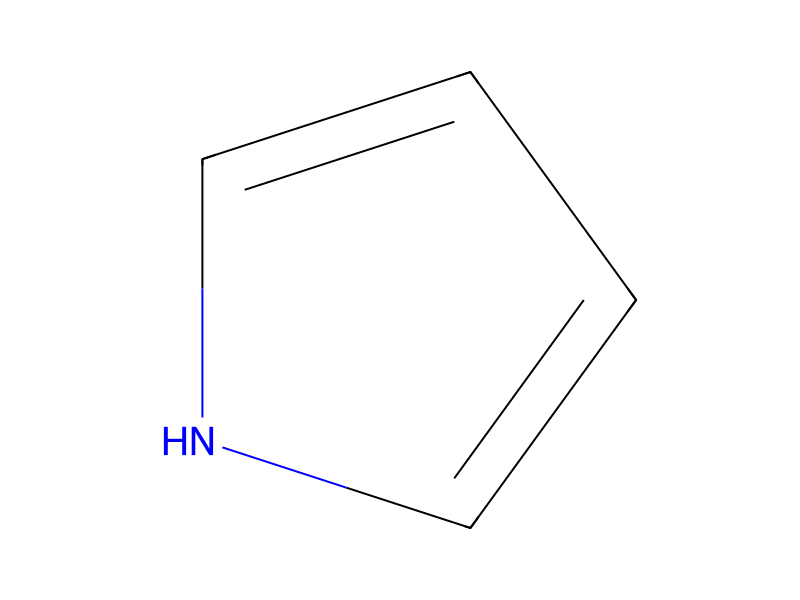
[NH:1]1[CH:5]=[CH:4][CH:3]=[CH:2]1.[CH:6](=O)[C:7]1[CH:12]=[CH:11][CH:10]=[CH:9][CH:8]=1>C(O)(C(F)(F)F)=O>[CH:10]1[CH:11]=[CH:12][C:7]([CH:6]([C:2]2[NH:1][CH:5]=[CH:4][CH:3]=2)[C:5]2[NH:1][CH:2]=[CH:3][CH:4]=2)=[CH:8][CH:9]=1Participants
Reactant 2

Product 1

Reagents, catalysts & solvents 1

Procedure
Gas Chromatography. We previously reported that the GC trace of the crude reaction mixture, obtained with TFA catalysis, shows three major peaks.16 The GC trace of the crude reaction mixture obtained with 0.1 equiv of InCl3 and a pyrrole:benzaldehyde ratio of 100:1 for 1 h also shows three major peaks (FIG. 2A) that are assigned as 1 (tR=16.4 min), 2 (tR=17.0 min) and 3 (tR=21.8 min) based on comparison with authentic samples. Closer scrutiny of the same GC trace upon amplification of the scale reveals a number of additional minor peaks (FIG. 2B). The appearance and intensity of these minor peaks depend on the reaction conditions (catalyst, reaction time, and pyrrole:benzaldehyde ratio). For example, some of the minor peaks seen in InCl3 catalyzed reactions are not observed in TFA catalyzed reactions.
Sources & evidence
- ORD record
- ord-bbd5890e03544b1e8e1a5851e25dc430
- Source dataset
- uspto-grants-2006_04
- Patent number
- US07022862B2
Reaction notes
Loading…