Triphenylphosphine → Methyl 2-(4-fluorophenyl)-4,5-dihydrooxazole-4-carboxylate
Reaction equation

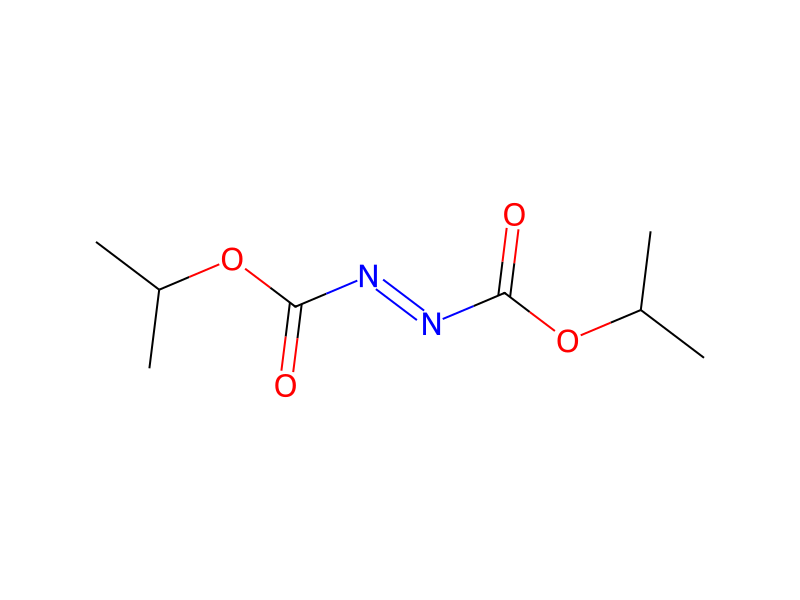
[F:1][C:2]1[CH:7]=[CH:6][C:5]([C:8]([NH:10][CH:11]([CH2:16][OH:17])[C:12]([O:14][CH3:15])=[O:13])=O)=[CH:4][CH:3]=1.C1(P(C2C=CC=CC=2)C2C=CC=CC=2)C=CC=CC=1.CC(OC(/N=N/C(OC(C)C)=O)=O)C>O1CCCC1>[F:1][C:2]1[CH:3]=[CH:4][C:5]([C:8]2[O:17][CH2:16][CH:11]([C:12]([O:14][CH3:15])=[O:13])[N:10]=2)=[CH:6][CH:7]=1Participants
5
Reactant 3


Product 1

Reagents, catalysts & solvents 1

Procedure
To 25 ml tetrahydrofuran was added methyl 2-[(4-fluorophenyl)carbonylamino]-3-hydroxypropanoate (0.750 g, 3 mmol), triphenylphosphine (1.0 g, 4.5 mmol) and diisopropylazodicarboxylate (0.800 g, 4.5 mmol). The reaction was stirred at room temperature under nitrogen until SM was shown to be consumed (TLC, 1:1 Ethyl Acetate:Hexane). The reaction mixture was concentrated under reduced pressure and purified using a Flash 40 Column (1:1 EtOAc:Hexane, 20 psi) to yield 1 g of methyl 2-(4-fluorophenyl)-1,3-oxazoline-4-carboxylate (M+1=224.2).
Workup
- customto be consumed (TLC, 1:1 Ethyl Acetate:Hexane)
- concentrationThe reaction mixture was concentrated under reduced pressure
- custompurified
Sources & evidence
- ORD record
- ord-cbe1af7a56af4ed992c609ec73216240
- Source dataset
- uspto-grants-2006_04
- Patent number
- US07026321B2
Reaction notes
Loading…