Propylamine → (2-Chloro-6,7-dihydrothieno[3,2-d]pyrimidin-4-yl)propylamine
Reaction equation

[Cl:1][C:2]1[N:3]=[C:4](Cl)[C:5]2[S:10][CH:9]=[CH:8][C:6]=2[N:7]=1.[CH2:12]([NH2:15])[CH2:13][CH3:14].C(N(C(C)C)C(C)C)C>O1CCCC1>[Cl:1][C:2]1[N:3]=[C:4]([CH2:14][CH2:13][CH2:12][NH2:15])[C:5]2[S:10][CH2:9][CH2:8][C:6]=2[N:7]=1Participants
5
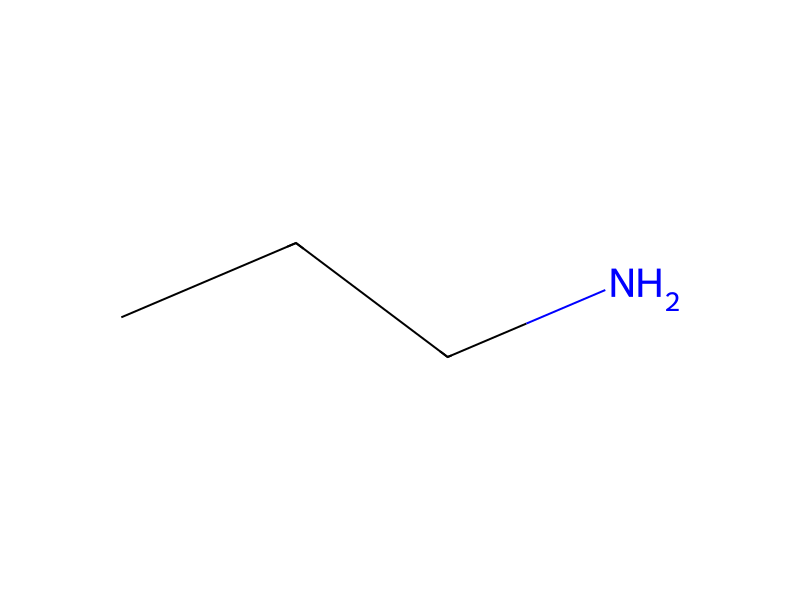




Procedure
10.4 g (50.2 mmol) of 2,4-dichlorothieno[3,2-d]pyrimidine (VII), 8.2 mL (100 mmol) of N-propylamine, and 17.5 mL (100 mmol) of N-ethyldiisopropylamine are placed in 100 mL of tetrahydrofuran and stirred for 20 hours at ambient temperature. The suspension is filtered, the filtrate is concentrated by evaporation. The residue is combined with 100 mL of water and treated in the ultrasound bath. Solid substance is suction filtered, dried, and stirred with 50 mL of petroleum ether. 10.0 g of the product VIII (86%) is obtained as a powder.
Workup
- filtrationThe suspension is filtered
- concentrationthe filtrate is concentrated by evaporation
- additiontreated in the ultrasound bath
- filtrationfiltered
- customdried
- stirringstirred with 50 mL of petroleum ether
Sources & evidence
- ORD record
- ord-dac3cef3c5ff4010a7ab817947fa74cc
- Source dataset
- uspto-grants-2013_01
- Patent number
- US08354531B2
Reaction notes
Loading…