Benzyl Alcohol → HCID 57421820, compound
Reaction equation

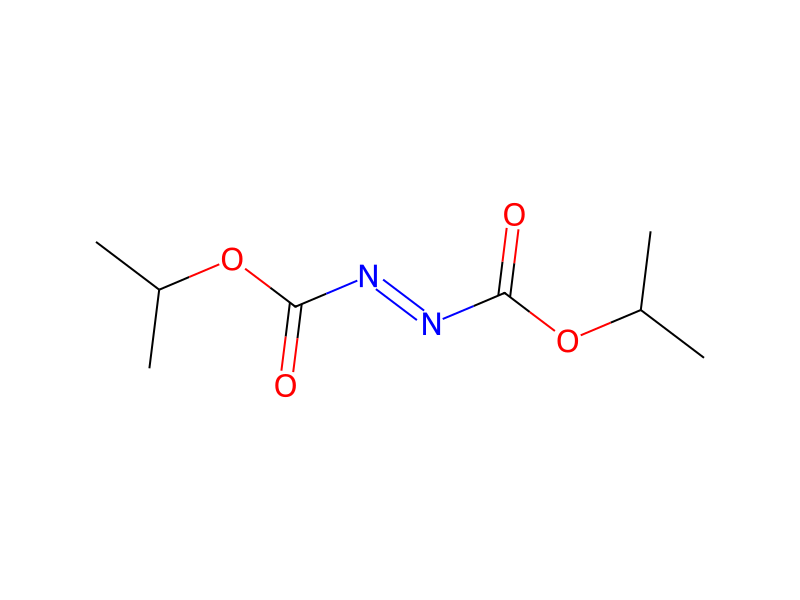
[CH3:1][O:2][C:3](=[O:11])[C:4]1[CH:9]=[C:8]([OH:10])[CH:7]=[N:6][CH:5]=1.C1(P(C2C=CC=CC=2)C2C=CC=CC=2)C=CC=CC=1.[CH2:31](O)[C:32]1[CH:37]=[CH:36][CH:35]=[CH:34][CH:33]=1.CC(OC(/N=N/C(OC(C)C)=O)=O)C>C1COCC1>[CH3:1][O:2][C:3](=[O:11])[C:4]1[CH:9]=[C:8]([O:10][CH2:31][C:32]2[CH:37]=[CH:36][CH:35]=[CH:34][CH:33]=2)[CH:7]=[N:6][CH:5]=1Participants





Procedure
0.31 g (2 mmol) of 5-hydroxy-nicotinic acid methyl ester and 3.1 g (4 mmol) of polymer-supported triphenylphosphine were combined in a flask charged with 45 mL of THF and 0.31 mL (3 mmol) of benzyl alcohol, and shaken at r.t. until the starting materials dissolved. The reaction mixture was then cooled to 0° C. with a water/brine bath, 0.58 mL (3 mmol) of DIAD was added and the reaction slurry then stirred overnight at r.t. The reaction mixture was filtered and the resin was washed 3 times with DCM/MeOH=1:1. The organic layer was then evaporated and flashed (EtOAc/hexanes=1:2) to give the desired 5-benzyloxy-nicotinic acid methyl ester, which was subsequently hydrolyzed according to general procedure B to give 5-benzyloxy-nicotinic acid which was used in the next step without further purification. LCMS: 230 (M+1)+.
Workup
- dissolutiondissolved
- temperatureThe reaction mixture was then cooled to 0° C. with a water/brine bath
- stirringthe reaction slurry then stirred overnight at r.t
- filtrationThe reaction mixture was filtered
- washthe resin was washed 3 times with DCM/MeOH=1:1
- customThe organic layer was then evaporated
Sources & evidence
- ORD record
- ord-7ad251a5c40247d4b27893327c9dd104
- Source dataset
- uspto-grants-2015_02
- Patent number
- US08946259B2
Reaction notes
Loading…