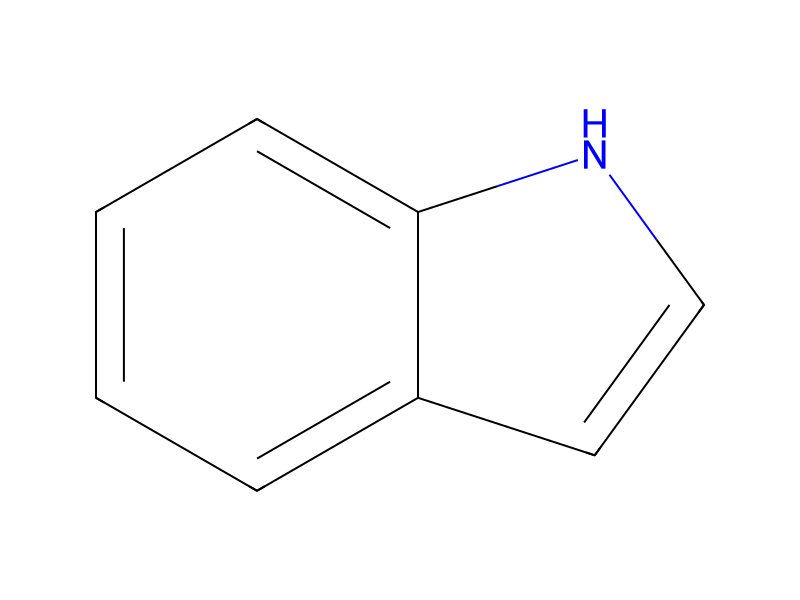
Cesium carbonate → Indole
Reaction equation

[N+]([C:4]1[NH:5][C:6]2[C:11]([CH:12]=1)=[CH:10][CH:9]=[CH:8][CH:7]=2)([O-])=O.C(=O)([O-])[O-].[Cs+].[Cs+].C(=O)([O-])[O-].[K+].[K+]>CN(C=O)C>[NH:5]1[C:6]2[C:11](=[CH:10][CH:9]=[CH:8][CH:7]=2)[CH:12]=[CH:4]1Participants
Reactant 3



Product 1
Reagents, catalysts & solvents 1

Procedure
Nitroindole AA1 was alkylated with an appropriately substituted alkyl or arylalkyl halide in the presence of a base such as cesium carbonate, potassium carbonate and the like also in the presence of a solvent such as DMF to provide a 1-substututed indole intermediate. The resulting intermediate was reacted with an amine such as pyrrolidine, piperidine and the like while dissolved in an organic acid such as glacial acetic acid in the presence of formaldehyde also in glacial acetic acid to provide a 3-substututed indole intermediate. The nitro group of the resulting intermediate was then reduced to an amino group by reaction with 1,1-dimethylhydrazine in the presence of an alcohol solvent such as MeOH and charcoal and ferric chloride hexahydrate which provided intermediate AA2.
Sources & evidence
- ORD record
- ord-3cec38179eba4e36b9522e251cdc033b
- Source dataset
- uspto-grants-2009_12
- Patent number
- US07629319B2
Reaction notes
Loading…