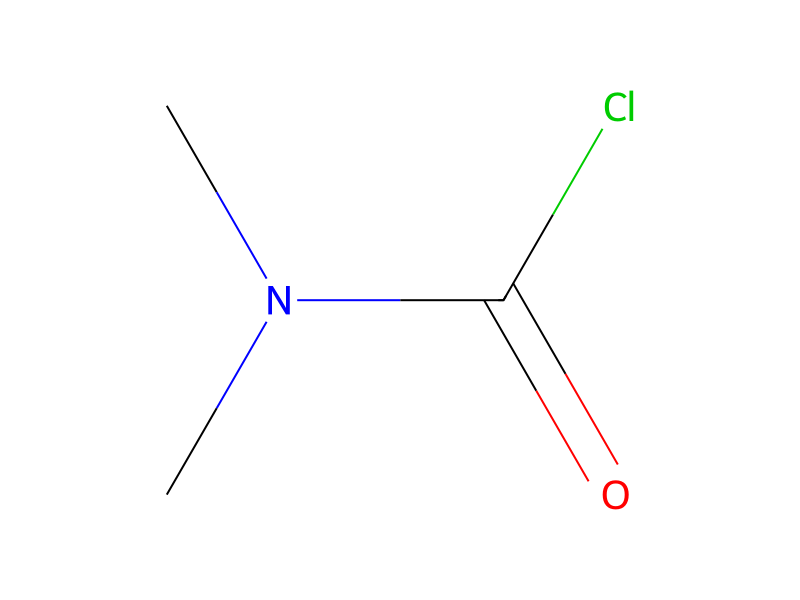
Dimethylcarbamoyl Chloride → HCID 66812986, compound
Reaction equation

[N+:1]1([O-])[CH:6]=[CH:5][CH:4]=[C:3]([C:7]([O:9][CH3:10])=[O:8])[C:2]=1[C:11]([O:13][CH3:14])=[O:12].C[Si]([C:20]#[N:21])(C)C.CN(C)C(Cl)=O.C([O-])(O)=O.[Na+]>COCCOC>[C:20]([C:6]1[N:1]=[C:2]([C:11]([O:13][CH3:14])=[O:12])[C:3]([C:7]([O:9][CH3:10])=[O:8])=[CH:4][CH:5]=1)#[N:21]Participants
6
Reactant 4



Product 1

Reagents, catalysts & solvents 1

Conditions
- Temperature
- 0 °C
Procedure
To a solution of dimethyl pyridine-2,3-dicarboxylate 1-oxide [Niiyami et al. (2002) Bioorg. Med. Chem. Lett. 12, 3041] (15.3 g, 72.5 mmol) and trimethylsilyl cyanide (15.7 mL, 117 mmol) in DME (161 mL) was added dimethylcarbamoyl chloride (10.5 mL, 114 mmol). The reaction mixture was heated at reflux for 72 h, and then cooled to 0° C. Saturated aqueous NaHCO3 (800 mL) was added slowly and the quenched mixture was extracted with EtOAc (2×1 L). The combined organic extracts were washed with brine (200 mL), dried over Na2SO4, filtered, and concentrated in vacuo. The crude product was purified by silica gel chromatography, eluting with a gradient of hexane:EtOAc—100:0 to 50:50, to give the title compound. MS: m/z=221 (M+1).
Workup
- temperatureThe reaction mixture was heated
- temperatureat reflux for 72 h
- extractionthe quenched mixture was extracted with EtOAc (2×1 L)
- washThe combined organic extracts were washed with brine (200 mL)
- dry with materialdried over Na2SO4
- filtrationfiltered
- concentrationconcentrated in vacuo
- customThe crude product was purified by silica gel chromatography
- washeluting with a gradient of hexane
Sources & evidence
- ORD record
- ord-eba78c74547f4e4faad2a137301ec9d5
- Source dataset
- uspto-grants-2009_12
- Patent number
- US07629338B2
Reaction notes
Loading…