Potassium Carbonate → HCID 67528343, compound
Reaction equation

Br[C:2]1[CH:7]=[CH:6][C:5]([CH2:8][CH2:9][OH:10])=[CH:4][CH:3]=1.[C:11]([C:13]1[CH:14]=[C:15](B(O)O)[CH:16]=[CH:17][CH:18]=1)#[N:12].C(=O)([O-])[O-].[K+].[K+]>[Br-].C([N+](CCCC)(CCCC)CCCC)CCC.O.C([O-])(=O)C.C([O-])(=O)C.[Pd+2]>[OH:10][CH2:9][CH2:8][C:5]1[CH:6]=[CH:7][C:2]([C:17]2[CH:16]=[CH:15][CH:14]=[C:13]([C:11]#[N:12])[CH:18]=2)=[CH:3][CH:4]=1Participants
7
Reactant 3


Product 1

Reagents, catalysts & solvents 3



Conditions
- Temperature
- 100 °C
Procedure
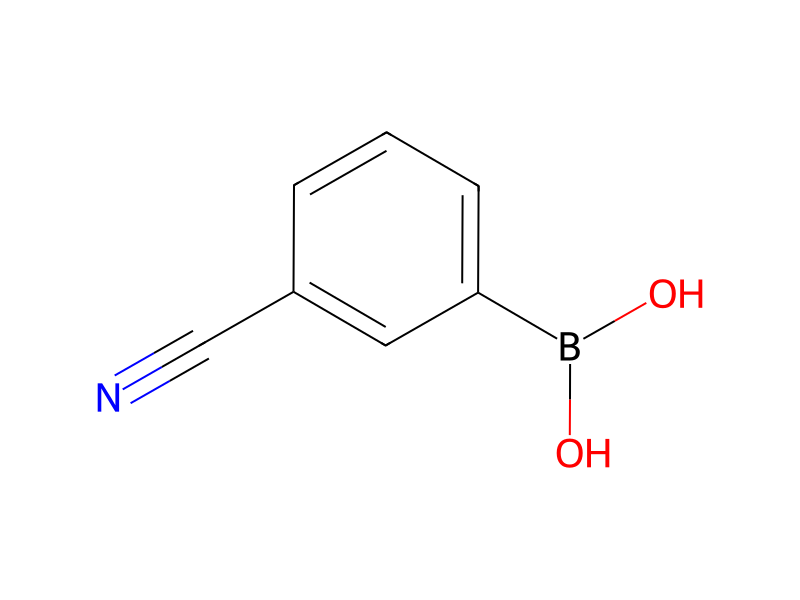
A mixture of 3 g (14.92 mmol) of 2-(4-bromophenyl)ethanol, 2.85 g (19.40 mmol) of 3-cyanophenylboronic acid, 5.15 g (37.30 mmol) of potassium carbonate, 4.81 g (14.92 mmol) of tetran-butylammonium bromide and 0.067 g (0.30 mmol) of palladium diacetate in 15 ml of water is heated at 100° C. under an argon atmosphere overnight. It is cooled to ambient temperature, diluted with water and extracted with ethyl acetate. The organic phase is dried over sodium sulphate and evaporated. It is subsequently purified by chromatography on silica gel, eluting with a 70/30 then 50/50 mixture of cyclohexane and ethyl acetate, to give 2.90 g of product in the form of an oil, which is used as it is in the following step.
Workup
- temperatureIt is cooled to ambient temperature
- extractionextracted with ethyl acetate
- dry with materialThe organic phase is dried over sodium sulphate
- customevaporated
- customIt is subsequently purified by chromatography on silica gel
- washeluting with a 70/30
- addition50/50 mixture of cyclohexane and ethyl acetate
Sources & evidence
- ORD record
- ord-1f7465575227425e989c725bbea15770
- Source dataset
- uspto-grants-2009_12
- Patent number
- US07632850B2
Reaction notes
Loading…