Ethyl Acetate → n-Methyl-hydroxybenzoquinoline
Reaction equation

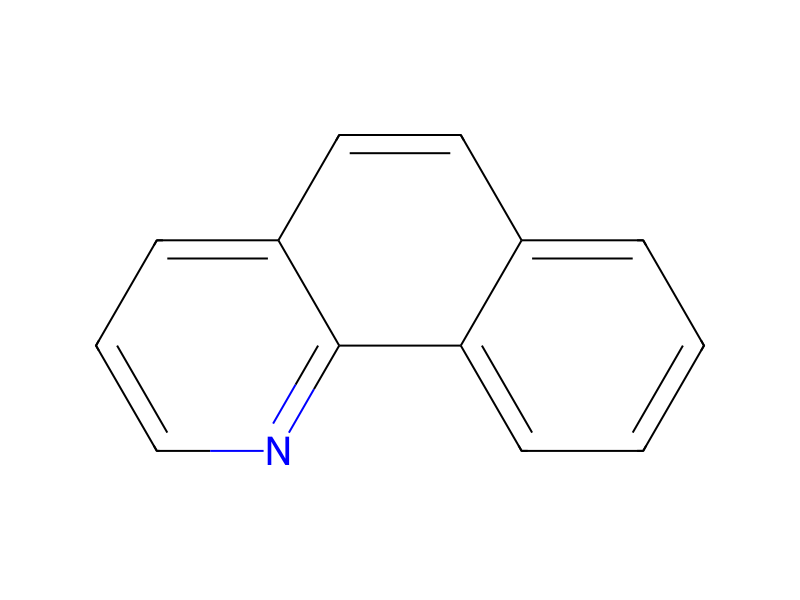
[N:1]1[C:10]2[C:5](=[CH:6][CH:7]=[C:8]3[CH:14]=[CH:13][CH:12]=[CH:11][C:9]3=2)[CH:4]=C[CH:2]=1.COC1C=NC2C(C=1)=CC=C1C=CC=CC=21.C([Li])CCC.CCO[C:39]([CH3:41])=[O:40]>C1COCC1>[CH3:2][N:1]1[C:10]2[C:5](=[CH:6][CH:7]=[C:8]3[CH:14]=[CH:13][CH:12]=[CH:11][C:9]3=2)[CH:4]=[CH:41][CH:39]1[OH:40]Participants
Reactant 4



Product 1

Reagents, catalysts & solvents 1

Procedure
Compound 13 was alkylated with Mel according to a general amino group alkylation procedure as follows. The 3-methoxybenzoquinoline derivative (100 mg) 13 was suspended in 5 mL of dry THF and cooled to -5° C. (ice/NaCl). 1.1 equivalents of n-butyl lithium (1 M) was added dropwise, and the reaction was stirred for 1 hour. 3 equivalents of the Mel alkylating agent was added slowly and the reaction was allowed to stir at room temperature for 2 hours. Aqueous work-up using NH4C1 and EtOAc gave a crude alkylated 3-methoxybenzoquinoline intermediate 14. Intermediate 14 was then purified by normal phase flash chromatography employing EtOAc: hexane (1:19) as the mobile phase (1HNMR: CD3Cl d 8.1 (broad d, 1 H, J=8.1 Hz), 7.68(dd, 1 H, J=8.1, 1.8 Hz), 7.34 (m, 2 H), 6.8 (s, 1 H), 3.92 (s, 3 H), 3.21 (m, 2 H), 2.94 (s, 3 H), 2.77 (t, 2H, J=6.6 Hz), 1.92 (m, 2 H)). Subsequent methoxy group deprotection by the general boron tribromide procedure described above in Example 1 resulted in the N-methyl-hydroxybenzoquinoline derivative 15.
Workup
- addition3 equivalents of the Mel alkylating agent was added slowly
- stirringto stir at room temperature for 2 hours
- customgave a crude alkylated 3-methoxybenzoquinoline intermediate 14
- customIntermediate 14 was then purified by normal phase flash chromatography
Sources & evidence
- ORD record
- ord-3ef72489c824454d9de620b18a7adc3c
- Source dataset
- uspto-grants-2000_08
- Patent number
- US06111116
Reaction notes
Loading…