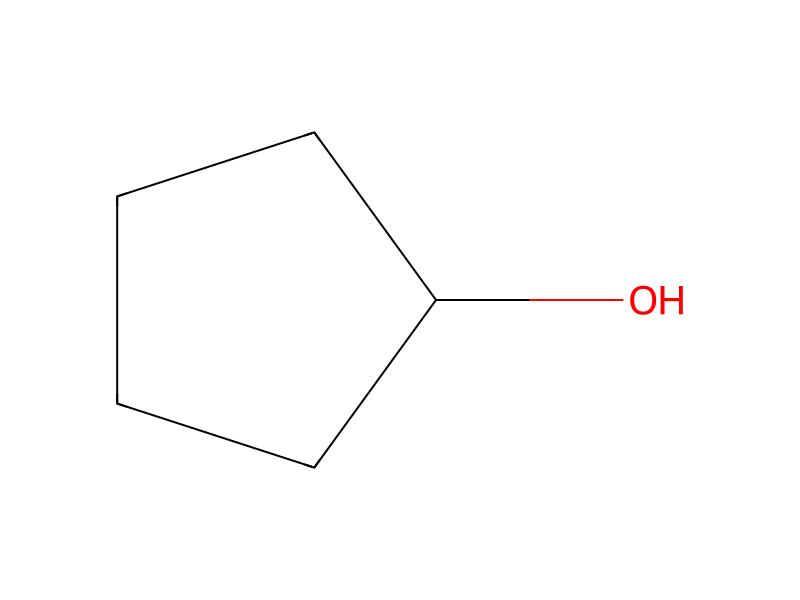
Cyclopentanol → HCID 17933263, compound
Reaction equation

[CH:1]1([OH:6])[CH2:5][CH2:4][CH2:3][CH2:2]1.[H-].[Na+].[Cl:9][C:10]1[CH:15]=[C:14](Cl)[N:13]=[CH:12][N:11]=1.[Cl-].[NH4+]>O1CCCC1>[Cl:9][C:10]1[CH:15]=[C:14]([O:6][CH:1]2[CH2:5][CH2:4][CH2:3][CH2:2]2)[N:13]=[CH:12][N:11]=1Participants
Reactant 4



Product 1

Reagents, catalysts & solvents 1

Conditions
- Temperature
- 0 °C
Procedure
A solution of cyclopentanol (2.25 g, 26.1 mmol) in tetrahydrofuran (12 ml) was added dropwise to a suspension of sodium hydride (1.31 g, 32.6 mmol) in tetrahydrofuran (48 ml) at 0° C. The mixture was stirred at 0° C. for 30 min and a solution of 4,6-dichloropyrimidine (3.6 g, 24.16 mmol) in tetrahydrofuran (12 ml) was added at 0° C. The reaction mixture was stirred at ambient temperature for 3 h and poured into sat. aqueous ammonium chloride and extracted with ethyl acetate. The organic layers were washed with water, dried over magnesium sulfate and concentrated in vacuo. The orange residue was purified by column chromatography (10-40% ethyl acetate/hexanes). To afford 4-chloro-6-(cyclopentyloxy)pyrimidine as a pale yellow oil. This material was used directly for the next reaction.
Workup
- stirringThe reaction mixture was stirred at ambient temperature for 3 h
- extractionextracted with ethyl acetate
- washThe organic layers were washed with water
- dry with materialdried over magnesium sulfate
- concentrationconcentrated in vacuo
- customThe orange residue was purified by column chromatography (10-40% ethyl acetate/hexanes)
Sources & evidence
- ORD record
- ord-9ba06e8b3aea475b9578ef8807272a38
- Source dataset
- uspto-grants-2012_11
- Patent number
- US08309577B2
Reaction notes
Loading…