4-Cyanobenzaldehyde → Methyl 2-(4-cyanobenzyl)-1,2,3,4-tetrahydroisoquinoline-7-carboxylate
Reaction equation

C(O[BH-](OC(=O)C)OC(=O)C)(=O)C.[Na+].Cl.[CH2:16]1[C:25]2[C:20](=[CH:21][CH:22]=[C:23]([C:26]([O:28][CH3:29])=[O:27])[CH:24]=2)[CH2:19][CH2:18][NH:17]1.[C:30]([C:32]1[CH:39]=[CH:38][C:35]([CH:36]=O)=[CH:34][CH:33]=1)#[N:31].C(=O)(O)[O-].[Na+]>ClCCl.C(OCC)C>[C:30]([C:32]1[CH:39]=[CH:38][C:35]([CH2:36][N:17]2[CH2:18][CH2:19][C:20]3[C:25](=[CH:24][C:23]([C:26]([O:28][CH3:29])=[O:27])=[CH:22][CH:21]=3)[CH2:16]2)=[CH:34][CH:33]=1)#[N:31]Participants
Reactant 4
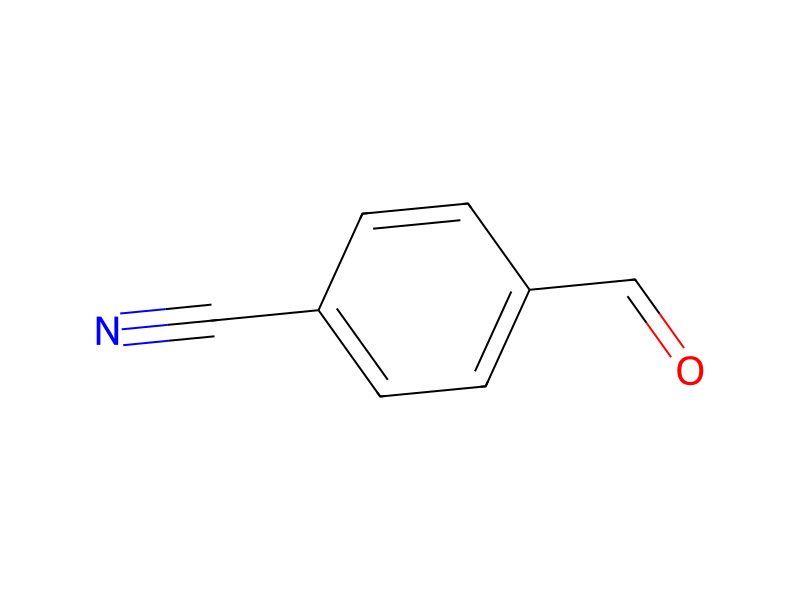



Product 1

Reagents, catalysts & solvents 2


Procedure
Sodium triacetoxyborohydride (2.2 g, 10.4 mmol) was added to a solution of methyl 1,2,3,4-tetrahydroisoquinoline-7-carboxylate hydrochloride (1.0 g, 4.4 mmol) and 4-cyanobenzaldehyde (0.83 g, 6.3 mmol) in dichloromethane (10 mL). The resulting reaction mixture was allowed to stir at room temperature overnight, poured over saturated sodium bicarbonate solution (75 mL) and extracted with dichloromethane (3×30 mL). The combined organic layer was washed with water (2×30 mL), dried (MgSO4), filtered and concentrated to give a foamy residue. Column chromatography (30% ethyl acetate/hexanes) provided methyl 2-(4-cyanobenzyl)-1,2,3,4-tetrahydroisoquinoline-7-carboxylate as a white crystalline solid upon trituration with ethyl ether (1.30 g, 97%). 1H NMR (CDCl3) δ 7.85 (1H, d, J=7.7 Hz); 7.72-7.58 (5H, m); 7.23 (1H, d, J=8.0 Hz); 4.00-3.98 (2H, m); 3.92 (3H, s); 3.83 (2H, br s); 3.08 (2H, br s); 2.97 (2H, br s). MS (M+H)+=307.
Workup
- customThe resulting reaction mixture
- extractionextracted with dichloromethane (3×30 mL)
- washThe combined organic layer was washed with water (2×30 mL)
- dry with materialdried (MgSO4)
- filtrationfiltered
- concentrationconcentrated
- customto give a foamy residue
Sources & evidence
- ORD record
- ord-31466db50f4c4998b1e60db0cbef8344
- Source dataset
- uspto-grants-2012_11
- Patent number
- US08314107B2
Reaction notes
Loading…