4-Methylmorpholine → 2-Bromo-4-methyl-N-(pyridin-3-ylmethyl)thiazole-5-carboxamide
Reaction equation

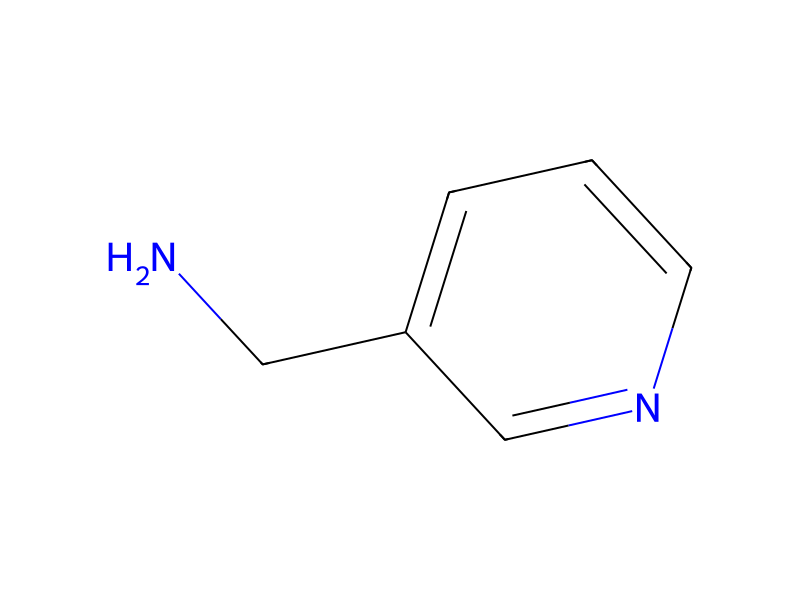
[Br:1][C:2]1[S:3][C:4]([C:8]([OH:10])=O)=[C:5]([CH3:7])[N:6]=1.CN1CCOCC1.ClC(OCC(C)C)=O.[NH2:26][CH2:27][C:28]1[CH:29]=[N:30][CH:31]=[CH:32][CH:33]=1>O1CCCC1>[Br:1][C:2]1[S:3][C:4]([C:8]([NH:26][CH2:27][C:28]2[CH:29]=[N:30][CH:31]=[CH:32][CH:33]=2)=[O:10])=[C:5]([CH3:7])[N:6]=1Participants
Reactant 4



Product 1

Reagents, catalysts & solvents 1

Procedure
To a solution of 2-bromo-4-methylthiazole-5-carboxylic acid (10.00 g, 45.00 mmol) and 4-methylmorpholine (6.5 mL, 59.0 mmol) in tetrahydrofuran (150 mL) was added isobutyl chloroformate (6.5 mL, 49.6 mmol) at 0° C. The resulting mixture was stirred at room temperature for 1 hour then 3-(aminomethyl)pyridine (5.2 mL, 51.4 mmol) was added. The reaction mixture was stirred at ambient temperature for 17 hours, then concentrated in vacuo. The residue was purified by column chromatography to afford 2-bromo-4-methyl-N-(pyridin-3-ylmethyl)thiazole-5-carboxamide in 52% yield (7.3 g): 1H NMR (300 MHz, CDCl3) δ 8.39-8.80 (m, 2H), 7.80-7.72 (m, 1H), 7.40-7.35 (m, 1H), 6.47 (br s, 1H), 4.60 (d, J=6.0 Hz, 2H), 2.64 (s, 3H); MS (ES+) m/z 312.1, 314.1 (M+1).
Workup
- stirringThe reaction mixture was stirred at ambient temperature for 17 hours
- concentrationconcentrated in vacuo
- customThe residue was purified by column chromatography
Sources & evidence
- ORD record
- ord-3132a29dc67a4a16bd5b985797b165c9
- Source dataset
- uspto-grants-2013_08
- Patent number
- US08501746B2
Reaction notes
Loading…