Chloride → HCID 68476398, compound
Reaction equation

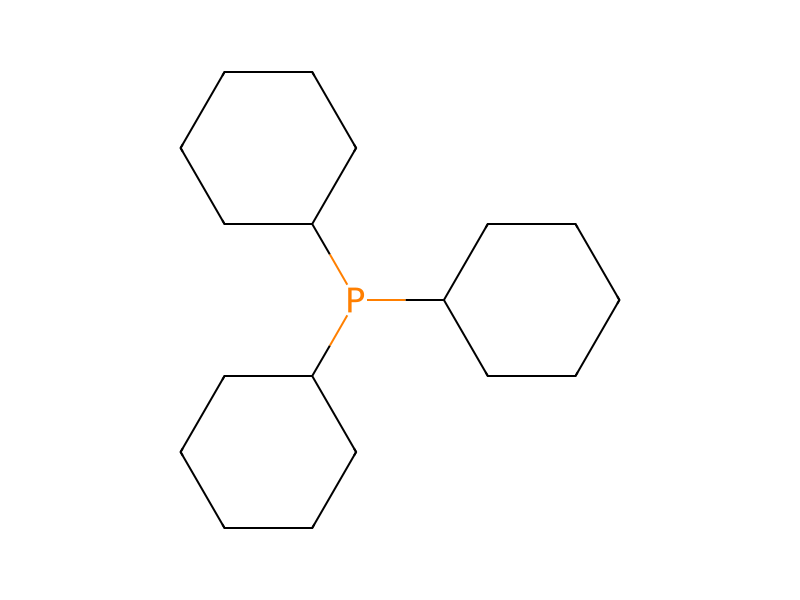
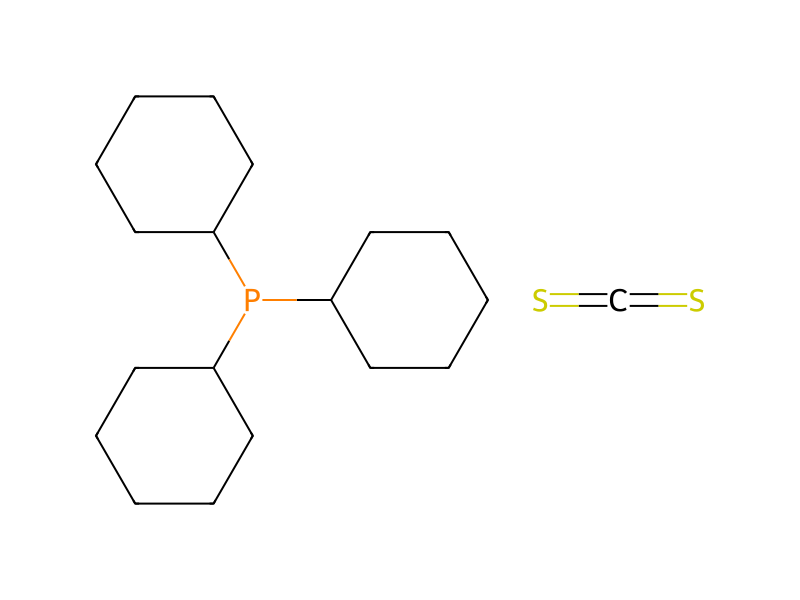
C(=S)=S.[CH:4]1([P:10]([CH:17]2[CH2:22][CH2:21][CH2:20][CH2:19][CH2:18]2)[CH:11]2[CH2:16][CH2:15][CH2:14][CH2:13][CH2:12]2)[CH2:9][CH2:8][CH2:7][CH2:6][CH2:5]1.[Cl-:23].Cl.C1(P(C2CCCCC2)C2CCCCC2)CCCCC1>C(O)C>[Cl-:23].[CH:17]1([PH+:10]([CH:4]2[CH2:5][CH2:6][CH2:7][CH2:8][CH2:9]2)[CH:11]2[CH2:16][CH2:15][CH2:14][CH2:13][CH2:12]2)[CH2:18][CH2:19][CH2:20][CH2:21][CH2:22]1Participants




Procedure
225 g cyclohexyl chloride and 750 ml diethylether are mixed. 100 ml of this mixture is added to 48.0 g magnesium turnings, and the reaction is started by adding 1 ml 1,2-dibromethane. The remaining cyclohexyl chloride mixture is added to the magnesium turnings within 3.5 hours under cooling at 38-40° C. The suspension is stirred again for one hour, cooled down to room temperature, and the cyclohexyl magnesium chloride solution is decanted from the remaining magnesium turnings. 156.7 g of the Grignard solution obtained in this manner is mixed with 120 ml tetrahydrofuran and slowly added to a mixture of 18.1 g phosphorus trichloride and 60 ml tetrahydrofuran at −20° C., and to an additional 100 ml tetrahydrofuran 20° C. After one hour of stirring at 37° C., the reaction mixture is added to 110 ml of a 15% ammonium chloride solution in water and 70 ml water at 20° C. The lower phase is separated and discarded. To the organic phase is added 10.1 g carbon disulfide. During this process, a reddish-brown precipitate is obtained, which is filtered off after 3 days, and washed three times each with 20 ml petrolether. After drying the solid at 35° C. under vacuum, 25.4 g (54%) of a tricyclohexylphosphine carbon disulfide adduct (CAS-Nr.: 4635-58-9) is obtained as a reddish-brown solid. From a mixture of 17.8 g of the tricyclohexyl phosphine carbon disulfide adduct and 100 ml ethanol, 80 ml of solvent is distilled off at 78-79° C. The oily residue is taken up in 80 ml tert-butylmethylether, and the tricyclohexyl phosphine solution is treated with hydrogen chloride at 20° C. The resulting suspension is diluted with 70 ml tert-butylmethylether. After complete precipitation of the tricyclohexyl phosphine as hydrochloride salt the solvent is evaporated off, and the solid residue is taken up in 100 ml tert-butylmethylether. The solid is filtered off, washed twice with 10 ml tert-butylmethylether each, and dried at 0.02 mbar. 13.1 g of a colorless hygroscopic solid is obtained. It contains 22.5% chloride so that it is assumed that in addition to the hydrochloride an additional equivalent hydrogen chloride is bound in the crystal (calculated for PCy3*2 HCl: 20.1% chloride). If a sample of the solid is left at open atmosphere, it will melt after one hour.
Workup
- distillationis distilled off at 78-79° C
- additionthe tricyclohexyl phosphine solution is treated with hydrogen chloride at 20° C
- additionThe resulting suspension is diluted with 70 ml tert-butylmethylether
- customAfter complete precipitation of the tricyclohexyl phosphine as hydrochloride salt the solvent
- customis evaporated off
- filtrationThe solid is filtered off
- washwashed twice with 10 ml tert-butylmethylether each, and
- customdried at 0.02 mbar
- custom13.1 g of a colorless hygroscopic solid is obtained
- waitIf a sample of the solid is left at open atmosphere, it
Sources & evidence
- ORD record
- ord-9012d6880e9144179321dbfda814b959
- Source dataset
- uspto-grants-2013_08
- Patent number
- US08501985B2
Reaction notes
Loading…