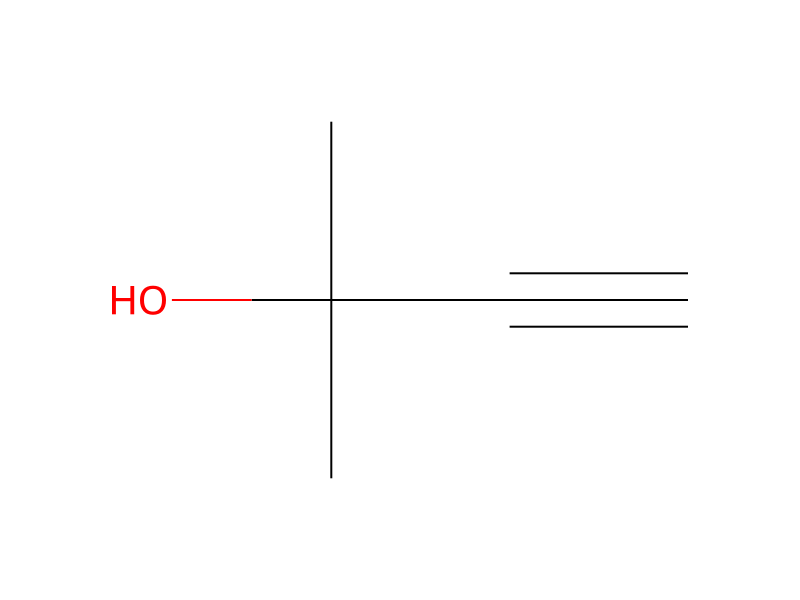
2-Methyl-3-butyn-2-ol → 4-(3,5-Dichloro-phenyl)-2-methyl-but-3-yn-2-ol
Reaction equation

[Cl:1][C:2]1[CH:3]=[C:4](I)[CH:5]=[C:6]([Cl:8])[CH:7]=1.C(N(CC)CC)C.[CH3:17][C:18]([OH:22])([C:20]#[CH:21])[CH3:19].C1(P(C2C=CC=CC=2)C2C=CC=CC=2)C=CC=CC=1>CCOCC.C([O-])(=O)C.[Pd+2].C([O-])(=O)C>[Cl:1][C:2]1[CH:3]=[C:4]([C:21]#[C:20][C:18]([CH3:19])([OH:22])[CH3:17])[CH:5]=[C:6]([Cl:8])[CH:7]=1Participants
7






Procedure
A mixture of 25.5 g (0.094 mole) of 3,5-dichloroiodobenzene, 550 ml dry triethylamine, 12 g (0.14 mole) of 2-methyl-2-hydroxy-3-butyne, 0.42 g (0.0019 mole) palladium (II) acetate, and 1 g (0.0038 mole) of triphenylphosphine was heated to reflux under nitrogen for four hours. The resulting mixture was cooled, diluted with ether and washed with two 500-ml portions of 3N hydrochloric acid. The ether layer was separated, dried over anhydrous magnesium sulfate, and evaporated in vacuo to yield the crude product as an oily residue. The purified product was obtained by distillation to yield 7.95 g, bp 115°-125° C./0.0001 mm.
Workup
- temperaturewas heated
- temperatureto reflux under nitrogen for four hours
- temperatureThe resulting mixture was cooled
- washwashed with two 500-ml portions of 3N hydrochloric acid
- customThe ether layer was separated
- dry with materialdried over anhydrous magnesium sulfate
- customevaporated in vacuo
Sources & evidence
- ORD record
- ord-3150efcc5a474e02b5f1d7ac1624ce0d
- Source dataset
- uspto-grants-1987_03
- Patent number
- US04652584
Reaction notes
Loading…