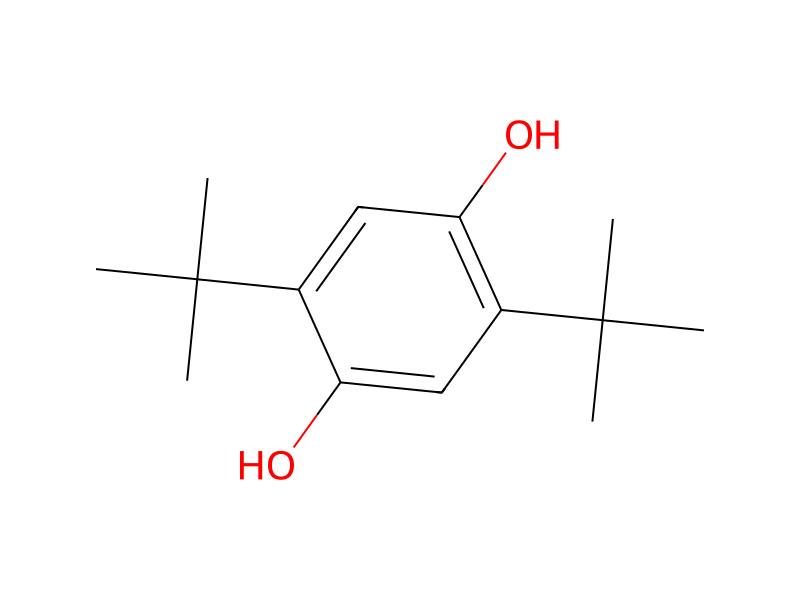
2,5-Di-tert-butylhydroquinone → HCID 59110799, compound
Reaction equation

[C:1]([C:5]1[CH:11]=[C:10]([OH:12])[C:9]([C:13]([CH3:16])([CH3:15])[CH3:14])=[CH:8][C:6]=1[OH:7])([CH3:4])([CH3:3])[CH3:2].[H-].[Na+].ClC[CH2:21][O:22][CH2:23][CH3:24]>C1COCC1>[CH3:21][O:22][CH2:23][CH2:24][O:12][C:10]1[CH:11]=[C:5]([C:1]([CH3:4])([CH3:3])[CH3:2])[C:6]([O:7][CH2:24][CH2:23][O:22][CH3:21])=[CH:8][C:9]=1[C:13]([CH3:16])([CH3:15])[CH3:14]Participants
Reactant 3


Product 1

Reagents, catalysts & solvents 1

Procedure
2,5-Di-tert-butylhydroquinone (0.2 mmol) was dissolved in anhydrous THF (20 ml). Sodium hydride (0.6 mmol) and 2-chloroethylethylether (0.4 mmol) was then added to the solution. The reaction mixture was then stirred at room temperature overnight. After removal of the solvent, the residue was partitioned between dichloromethane and aqueous NaHCO3 (0.1M). The organic portion was separated and dried over Na2SO4. After solvent removal in vacuo, the crude product was chromatographed (silica, hexanes/DCM from 5:1 to 1:1) to afford 1,4-bis(2-methoxyethoxy)-2,5-di-tert-butyl-benzene in an 81% yield. The product was characterized by 1H NMR (300 MHz, CDCl3, δ/ppm): 7.14 (s, 2H), 4.11 (t, J=4.5 Hz, 4H), 3.80 (t, J=4.5 Hz, 4H), 3.45 (s, 6H), 1.37 (s, 18H).
Workup
- customAfter removal of the solvent
- customthe residue was partitioned between dichloromethane and aqueous NaHCO3 (0.1M)
- customThe organic portion was separated
- dry with materialdried over Na2SO4
- customAfter solvent removal in vacuo
- customthe crude product was chromatographed (silica, hexanes/DCM from 5:1 to 1:1)
Sources & evidence
- ORD record
- ord-d9dc7b4ef8d842349f87adff41a6a4e0
- Source dataset
- uspto-grants-2013_12
- Patent number
- US08609287B2
Reaction notes
Loading…