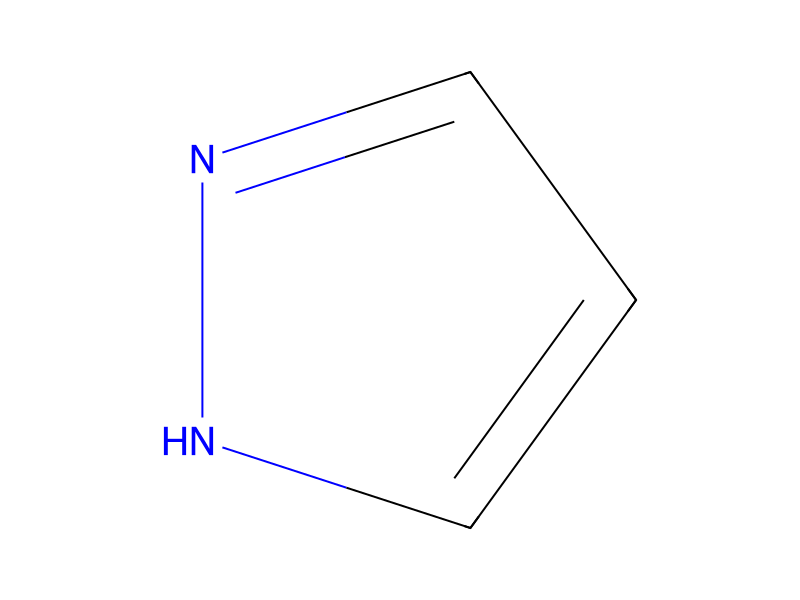
Pyrazole → HCID 66879745, compound
Reaction equation

F[C:2]1[CH:3]=[N:4][CH:5]=[CH:6][C:7]=1[C:8]1[O:9][C:10]2[CH:16]=[CH:15][C:14]([C:17]([F:20])([F:19])[F:18])=[CH:13][C:11]=2[N:12]=1.[NH:21]1[CH:25]=[CH:24][CH:23]=[N:22]1.C(=O)([O-])[O-].[K+].[K+].CN(C=O)C>O>[N:21]1([C:2]2[CH:3]=[N:4][CH:5]=[CH:6][C:7]=2[C:8]2[O:9][C:10]3[CH:16]=[CH:15][C:14]([C:17]([F:20])([F:19])[F:18])=[CH:13][C:11]=3[N:12]=2)[CH:25]=[CH:24][CH:23]=[N:22]1Participants
6





Conditions
- Temperature
- 50 °C
Procedure
A mixture of 0.24 g of 2-(3-fluoropyridin-4-yl)-5-(trifluoromethyl)benzoxazole, 0.14 g of pyrazole, 0.69 g of potassium carbonate and 4 ml of DMF was stirred while heating at 50° C. for two hours. Water was added to the reaction mixture, followed by extraction with ethyl acetate twice. The combined organic layers were washed with a saturated sodium chloride solution, dried over anhydrous magnesium sulfate, and concentrated under reduced pressure. The residue was subjected to silica gel column chromatography to give 0.22 g of 2-[3-(pyrazole-1-yl)pyridin-4-yl]-5-(trifluoromethyl)benzoxazole (hereinafter, referred to as “active compound 58”).
Workup
- extractionfollowed by extraction with ethyl acetate twice
- washThe combined organic layers were washed with a saturated sodium chloride solution
- dry with materialdried over anhydrous magnesium sulfate
- concentrationconcentrated under reduced pressure
Sources & evidence
- ORD record
- ord-cd17c64451f44c6eb7e6656f0f1d2dbd
- Source dataset
- uspto-grants-2013_12
- Patent number
- US08609705B2
Reaction notes
Loading…