Hydrochloric Acid → HCID 73602952, compound
Reaction equation

[NH2:1][C:2]1[CH:3]=[N:4][N:5]([CH3:24])[C:6]=1[CH:7]1[CH2:13][CH2:12][CH:11]([NH:14]C(=O)OC(C)(C)C)[CH:10]([O:22][CH3:23])[CH2:9][CH2:8]1.CCN(C(C)C)C(C)C.C1CN([P+](ON2N=NC3C=CC=CC2=3)(N2CCCC2)N2CCCC2)CC1.F[P-](F)(F)(F)(F)F.C(OC([NH:74][C:75]1[S:79][C:78]([C:80]2[CH:85]=[CH:84][CH:83]=[CH:82][C:81]=2[F:86])=[N:77][C:76]=1[C:87](O)=[O:88])=O)(C)(C)C.Cl.O1CCOCC1>C(Cl)Cl.CO>[NH2:74][C:75]1[S:79][C:78]([C:80]2[CH:85]=[CH:84][CH:83]=[CH:82][C:81]=2[F:86])=[N:77][C:76]=1[C:87]([NH:1][C:2]1[CH:3]=[N:4][N:5]([CH3:24])[C:6]=1[CH:7]1[CH2:8][CH2:9][C@H:10]([O:22][CH3:23])[C@@H:11]([NH2:14])[CH2:12][CH2:13]1)=[O:88]Participants
Reactant 6



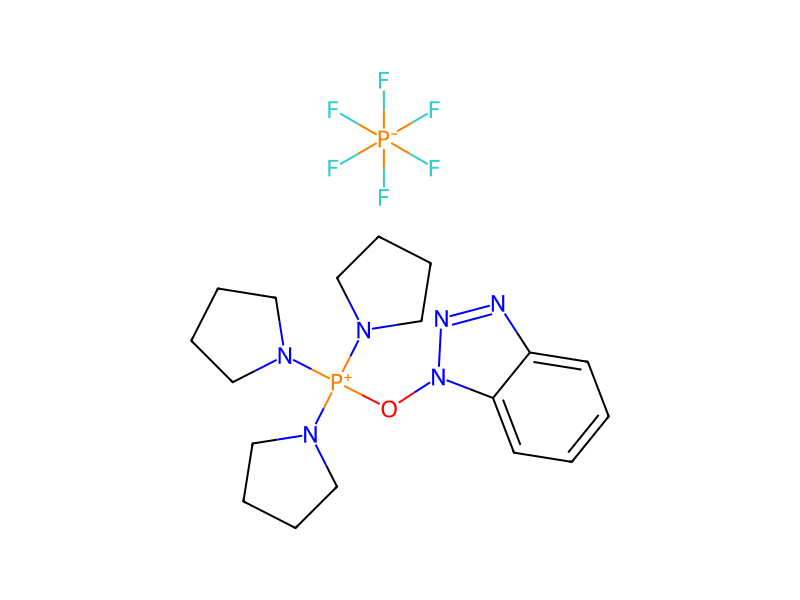


Product 1

Reagents, catalysts & solvents 2


Procedure
A solution of tert-butyl 5-fluoro-2-methoxy-5-(1-methyl-4-nitro-1H-pyrazol-5-yl)cycloheptylcarbamate (430 mg, 1.27 mmol) in MeOH (50 mL) was passed through the H-Cube® (full H2, 70° C., flow rate: 1 mL/min, 30 mm 10% Pd/C cartridge). The solvent was removed under reduced pressure to give an orange foam. This foam was then dissolved in MeOH (70 mL) and 10% palladium on carbon (45 mg) added. The mixture was then stirred under an atmosphere of H2 (400 psi) at room temperature for 3 hr, filtered through Celite® and the solvent removed under reduced pressure to give a complex mixture as an orange foam (378 mg) containing tert-butyl 5-(4-amino-1-methyl-1H-pyrazol-5-yl)-2-methoxycycloheptylcarbamate. To a solution of this mixture (378 mg, 1.13 mmol) in DCM (30 mL) was added DIPEA (1.0 mL, 5.74 mmol), PyBOP (1.5 g, 2.81 mmol) and 5-(tert-butoxycarbonyl-amino)-2-(2-fluorophenyl)thiazole-4-carboxylic acid (418 mg, 1.24 mmol) and the mixture was stirred at room temperature for 18 hr. The mixture was diluted with DCM (150 mL) and washed with water (30 mL). The organic layer was separated, dried over MgSO4 and the solvent removed under reduced pressure. Purification via silica gel column chromatography (70-80% EtOAc/isohexane) gave a mixture of four diastereomers as a peach solid (240 mg) which were separated by preparative HPLC. Each diastereomer (25 mg, 0.03 mmol) was then stirred with HCl in dioxane (4 M, 0.95 mL, 3.80 mmol) in MeOH (1 mL) at room temperature for 18 hr. The solvents were removed under reduced pressure and the crude residue was re-dissolved in MeOH and loaded onto an SCX column. The column was washed with MeOH, eluted with 7 N ammonia in MeOH to give 413 (Diastereomer 1) as an off-white solid (13 mg, 2% over three steps). 1H NMR (400 MHz, CDCl3) δ 8.43 (s, 1H), 8.21 (td, J=7.7, 1.9 Hz, 1H), 7.79 (s, 1H), 7.38-7.32 (m, 1H), 7.26-7.21 (m, 1H), 7.16 (dd, J=11.4, 8.3 Hz, 1H), 6.09 (s, 2H), 3.84 (s, 3H), 3.36 (s, 3H), 3.11-2.99 (m, 2H), 2.91-2.84 (m, 1H), 2.13-2.02 (m, 2H), 1.98-1.91 (m, 2H), 1.85 (t, J=12.3 Hz, 4H), 1.58-1.46 (m, 2H). LCMS (ES+) m/z 459 (M+1)
Workup
- washwashed with water (30 mL)
- customThe organic layer was separated
- dry with materialdried over MgSO4
- customthe solvent removed under reduced pressure
- customPurification via silica gel column chromatography (70-80% EtOAc/isohexane)
- customgave
- customwere separated by preparative HPLC
- customThe solvents were removed under reduced pressure
- dissolutionthe crude residue was re-dissolved in MeOH
- washThe column was washed with MeOH
- washeluted with 7 N ammonia in MeOH
Sources & evidence
- ORD record
- ord-55ef6828be9e436c86896eefe1be8368
- Source dataset
- uspto-grants-2013_12
- Patent number
- US08614206B2
Reaction notes
Loading…