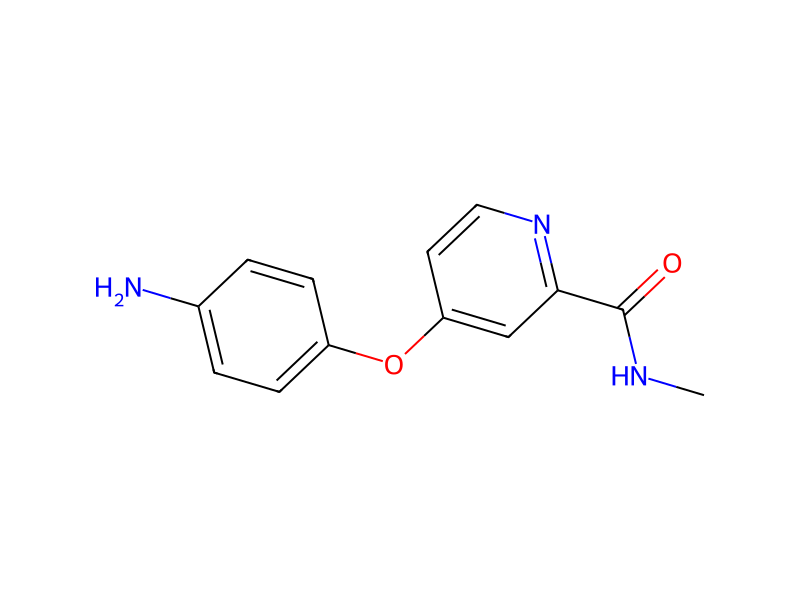
4-Aminophenol → 4-(4-Aminophenoxy)-N-methylpicolinamide
Reaction equation

[NH2:1][C:2]1[CH:7]=[CH:6][C:5]([OH:8])=[CH:4][CH:3]=1.CC(C)([O-])C.[K+].Cl[C:16]1[CH:21]=[CH:20][N:19]=[C:18]([C:22]([NH:24][CH3:25])=[O:23])[CH:17]=1.C([O-])([O-])=O.[K+].[K+]>CN(C=O)C>[CH3:25][NH:24][C:22]([C:18]1[CH:17]=[C:16]([O:8][C:5]2[CH:6]=[CH:7][C:2]([NH2:1])=[CH:3][CH:4]=2)[CH:21]=[CH:20][N:19]=1)=[O:23]Participants





Conditions
- Temperature
- 80 °C
Procedure
4-Chloro-N-methyl-2-pyridinecarboxamide is first synthesized from 4-chloropyridine-2-carbonyl chloride by adding 4-chloropyridine-2-carbonyl chloride HCl salt (7.0 g, 32.95 mmol) in portions to a mixture of a 2.0 M methylamine solution in THF (100 mL) and MeOH (20 mL) at 0° C. The resulting mixture is stored at 3° C. for 4 h, then concentrated under reduced pressure. The resulting nearly dry solids are suspended in EtOAc (100 mL) and filtered. The filtrate is washed with a saturated NaCl solution (2×100 mL), dried (Na2SO4) and concentrated under reduced pressure to provide 4-chloro-N-methyl-2-pyridinecarboxamide as a yellow, crystalline solid. Step 2: A solution of 4-aminophenol (9.60 g, 88.0 mmol) in anh. DMF (150 mL) is treated with potassium tert-butoxide (10.29 g, 91.7 mmol), and the reddish-brown mixture is stirred at room temp. for 2 h. The contents are treated with 4-chloro-N-methyl-2-pyridinecarboxamide (15.0 g, 87.9 mmol) from Step 1 and K2CO3 (6.50 g, 47.0 mmol) and then heated at 80° C. for 8 h. The mixture is cooled to room temp. and separated between EtOAc (500 mL) and a saturated NaCl solution (500 mL). The aqueous phase is back-extracted with EtOAc (300 mL). The combined organic layers are washed with a saturated NaCl solution (4×1000 mL), dried (Na2SO4) and concentrated under reduced pressure. The resulting solids are dried under reduced pressure at 35° C. for 3 h to afford 4-(2-(N-methylcarbamoyl)-4-pyridyloxy)aniline as a light-brown solid. 1H-NMR (DMSO-d6) δ 2.77 (d, J=4.8 Hz, 3H), 5.17 (br s, 2H), 6.64, 6.86 (AA′BB′ quartet, J=8.4 Hz, 4H), 7.06 (dd, J=5.5, 2.5 Hz, 1H), 7.33 (d, J=2.5 Hz, 1H), 8.44 (d, J=5.5 Hz, 1H), 8.73 (br d, 1H); HPLC ES-MS m/z 244 ((M+H)+). Step 3: A solution of 4-chloro-3-(trifluoromethyl)phenyl isocyanate (14.60 g, 65.90 mmol) in CH2Cl2 (35 mL) is added dropwise to a suspension of 4-(2-(N-methylcarbamoyl)-4-pyridyloxy)aniline from Step 2; (16.0 g, 65.77 mmol) in CH2Cl2 (35 mL) at 0° C. The resulting mixture is stirred at room temp. for 22 h. The resulting yellow solids are removed by filtration, then washed with CH2Cl2 (2×30 mL) and dried under reduced pressure (approximately 1 mmHg) to afford N-(4-chloro-3-(trifluoromethyl)phenyl)-N′-(4-(2-(N-methylcarbamoyl)-4-pyridyloxy)phenyl)urea as an off-white solid: mp 207-209° C.; 1H-NMR (DMSO-d6) δ 2.77 (d, J=4.8 Hz, 3H), 7.16 (m, 3H), 7.37 (d, J=2.5 Hz, 1H), 7.62 (m, 4H), 8.11 (d, J=2.5 Hz, 1H), 8.49 (d, J=5.5 Hz, 1H), 8.77 (br d, 1H), 8.99 (s, 1H), 9.21 (s, 1H); HPLC ES-MS m/z 465 ((M+H)+).
Workup
- temperatureThe mixture is cooled to room temp.
- customseparated between EtOAc (500 mL)
- extractionThe aqueous phase is back-extracted with EtOAc (300 mL)
- washThe combined organic layers are washed with a saturated NaCl solution (4×1000 mL)
- dry with materialdried (Na2SO4)
- concentrationconcentrated under reduced pressure
- customThe resulting solids are dried under reduced pressure at 35° C. for 3 h
Sources & evidence
- ORD record
- ord-9be01f97642b4f5cab78c34040551b83
- Source dataset
- uspto-grants-2013_12
- Patent number
- US08618141B2
Reaction notes
Loading…