Hydrochloric Acid → 1-Methyl-4-(6-nitropyridin-3-yl)piperazine
Reaction equation

Br[C:2]1[CH:3]=[CH:4][C:5]([N+:8]([O-:10])=[O:9])=[N:6][CH:7]=1.C([O-])([O-])=O.[K+].[K+].[CH3:17][N:18]1[CH2:23][CH2:22][NH:21][CH2:20][CH2:19]1.Cl>CS(C)=O.[I-].C([N+](CCCC)(CCCC)CCCC)CCC>[CH3:17][N:18]1[CH2:23][CH2:22][N:21]([C:2]2[CH:7]=[N:6][C:5]([N+:8]([O-:10])=[O:9])=[CH:4][CH:3]=2)[CH2:20][CH2:19]1Participants
7
Reactant 4



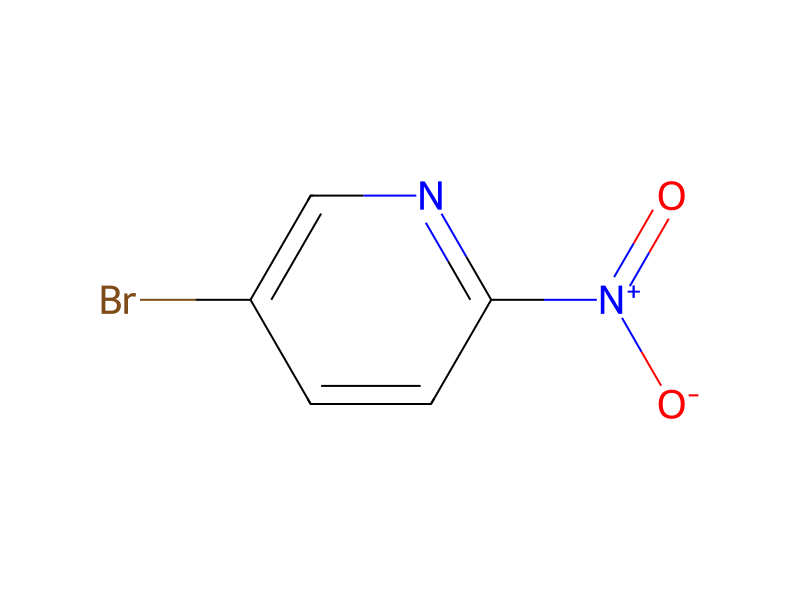
Product 1

Reagents, catalysts & solvents 2


Procedure
According to US 2009/0318448, into a solution of 5-bromo-2-nitropyridine (2.0 g, 9.85 mmol) in DMSO (10 mL) was added K2CO3 (2.72 g, 19.7 mmol) and 1-methylpiperazine (1.64 mL, 14.8 mmol), and tetrabutylammonium iodide (36 mg). The mixture was stirred at 120 degree C. for overnight. It was allowed to cool down and acidified with 1N HCl. The mixture was extracted with DCM. The aqueous layer was basified with saturated Na2CO3, and further extracted with DCM. The combined organic layers were dried over Na2SO4 and concentrated to give a brown solid, which was washed with small amount of water. The solid was dried under vacuum to give 2.16 g of 1-methyl-4-(6-nitropyridin-3-yl)piperazine (99% yield) as a yellow powder. LCMS: (M+H)+ 223
Workup
- temperatureto cool down
- extractionThe mixture was extracted with DCM
- extractionfurther extracted with DCM
- dry with materialThe combined organic layers were dried over Na2SO4
- concentrationconcentrated
- customto give a brown solid, which
- washwas washed with small amount of water
- customThe solid was dried under vacuum
Sources & evidence
- ORD record
- ord-7f5858db848749d0bdf537723b085cac
- Source dataset
- uspto-grants-2013_12
- Patent number
- US08618107B2
Reaction notes
Loading…