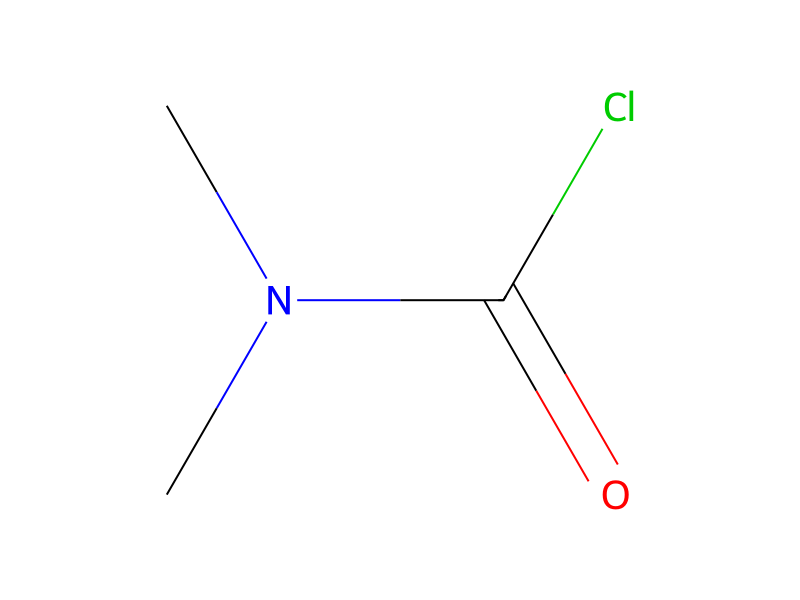
Dimethylcarbamoyl Chloride → (R)-tert-butyl 2-(3,3-dimethylureido)-2-phenylacetate
Reaction equation

[C:1]([O:5][C:6](=[O:15])[C@H:7]([NH2:14])[C:8]1[CH:13]=[CH:12][CH:11]=[CH:10][CH:9]=1)([CH3:4])([CH3:3])[CH3:2].CCN(C(C)C)C(C)C.[CH3:25][N:26]([CH3:30])[C:27](Cl)=[O:28]>CN(C=O)C>[CH3:25][N:26]([CH3:30])[C:27](=[O:28])[NH:14][C@H:7]([C:8]1[CH:13]=[CH:12][CH:11]=[CH:10][CH:9]=1)[C:6]([O:5][C:1]([CH3:4])([CH3:2])[CH3:3])=[O:15]Participants




Procedure
To a stirred solution of (R)-tert-butyl-2-amino-2-phenylacetate (1.0 g, 4.10 mmol) and Hunig's base (1.79 mL, 10.25 mmol) in DMF (40 mL) was added dimethylcarbamoyl chloride (0.38 mL, 4.18 mmol) dropwise over 10 minutes. After stirring at room temperature for 3 hours, the reaction was concentrated under reduced pressure and the resulting residue was dissolved in ethyl acetate. The organic layer was washed with H2O, 1N aq. HCl and brine, dried (MgSO4), filtered and concentrated under reduced pressure. (R)-tert-butyl 2-(3,3-dimethylureido)-2-phenylacetate was obtained as a white solid (0.86 g; 75%) and used without further purification. 1H NMR (500 MHz, DMSO-d6) δ ppm 1.33 (s, 9H) 2.82 (s, 6H) 5.17 (d, J=7.63 Hz, 1H) 6.55 (d, J=7.32 Hz, 1H) 7.24-7.41 (m, 5H). LCMS: Anal. Calcd. for C15H22N2O3 278.16. Found 279.23 (M+H)+; HPLC PHENOMENEX® Luna C-18 4.6×50 mm, 0 to 100% B over 4 minutes, 1 minute hold time, A=90% water, 10% methanol, 0.1% TFA, B=10% water, 90% methanol, 0.1% TFA, RT=2.26 min, 97% homogeneity index.
Workup
- concentrationthe reaction was concentrated under reduced pressure
- dissolutionthe resulting residue was dissolved in ethyl acetate
- washThe organic layer was washed with H2O, 1N aq. HCl and brine
- dry with materialdried (MgSO4)
- filtrationfiltered
- concentrationconcentrated under reduced pressure
Sources & evidence
- ORD record
- ord-53ae880449d14a33bd32151b989ba824
- Source dataset
- uspto-grants-2013_12
- Patent number
- US08618153B2
Reaction notes
Loading…