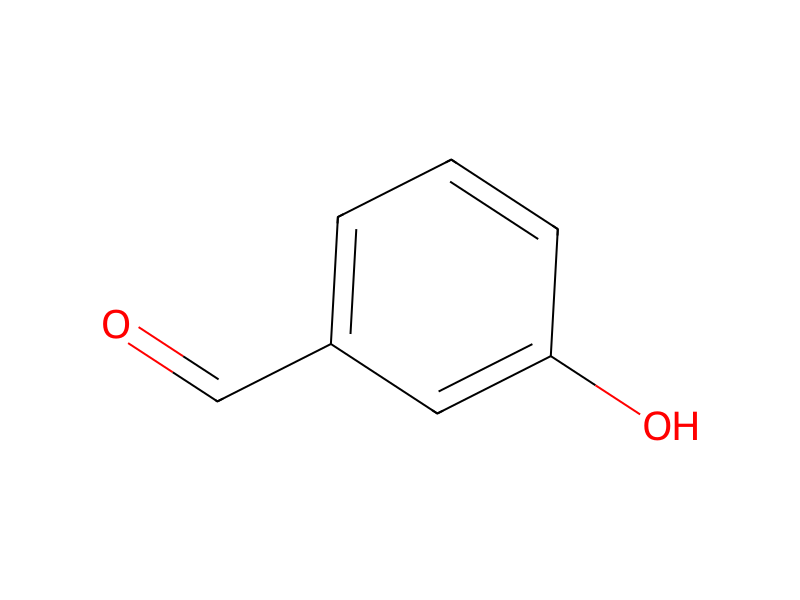
3-Hydroxybenzaldehyde → 3-(t-Butyldimethylsilyloxy)benzaldehyde
Reaction equation

[OH:1][C:2]1[CH:3]=[C:4]([CH:7]=[CH:8][CH:9]=1)[CH:5]=[O:6].CCN(CC)CC.[CH3:17][C:18]([Si:21](Cl)([CH3:23])[CH3:22])([CH3:20])[CH3:19]>CN(C1C=CN=CC=1)C.C(Cl)Cl>[Si:21]([O:1][C:2]1[CH:3]=[C:4]([CH:7]=[CH:8][CH:9]=1)[CH:5]=[O:6])([C:18]([CH3:20])([CH3:19])[CH3:17])([CH3:23])[CH3:22]Participants
6





Conditions
- Temperature
- 0 °C
Procedure
Into a round bottom flask containing 3-hydroxybenzaldehyde (0.658 g, 5.23 mmol) and DMAP (0.0646 g, 0.52 mmol), first 10 mL of anhydrous CH2Cl2 and then 0.89 mL of NEt3 (0.634 g, 6.27 mmol) were added. After the reaction mixture was stirred under nitrogen at 0° C. for 10 minutes, 5 mL of a CH2Cl2 solution of TBSCl (0.976 g, 6.28 mmol) were added. The reaction mixture was stirred for 2.5 h at room temperature and, then it was filtered through silica gel-florisil, rinsed with CH2Cl2 and the organic phase dried under Na2SO4. After evaporating the solvent, 1.1308 g (4.79 mmol) of pure product was obtained in a 92% yield.
Workup
- stirringThe reaction mixture was stirred for 2.5 h at room temperature
- filtrationit was filtered through silica gel-florisil
- washrinsed with CH2Cl2
- customthe organic phase dried under Na2SO4
- customAfter evaporating the solvent
Sources & evidence
- ORD record
- ord-d6b7885d7f7d4d7bbd4aada9a2b71553
- Source dataset
- uspto-grants-2012_05
- Patent number
- US08173696B2
Reaction notes
Loading…