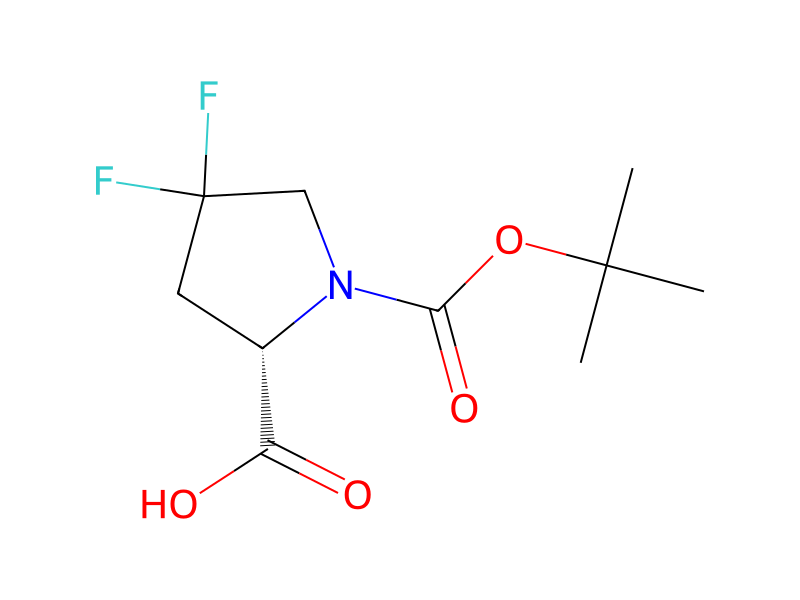
Lithium Hydroxide → (2S)-1-[(tert-butoxy)carbonyl]-4,4-difluoropyrrolidine-2-carboxylic acid
Reaction equation

[C:1]([O:5][C:6]([N:8]1[CH2:12][C:11]([F:14])([F:13])[CH2:10][C@H:9]1[C:15]([O:17]C)=[O:16])=[O:7])([CH3:4])([CH3:3])[CH3:2].[OH-].[Li+]>C1COCC1.C(OCC)(=O)C>[C:1]([O:5][C:6]([N:8]1[CH2:12][C:11]([F:13])([F:14])[CH2:10][C@H:9]1[C:15]([OH:17])=[O:16])=[O:7])([CH3:4])([CH3:2])[CH3:3]Participants
5




Procedure
Methyl (2S)—N-(tert-butyloxycarbonyl)-4,4-difluoropyrrolidine-2-carboxylate (2.2 g, 8.3 mmol) was dissolved in THF (100 ml). Aqueous lithium hydroxide (1M, 10.6 ml, 10.6 mmol) was added. After 3 h at room temperature the reaction mixture was diluted with ethyl acetate (150 ml), washed with 1M HCl, water, and brine, dried (Na2SO4) and evaporated in vacuo. The residue was purified by flash chromatography (eluant: 95% chloroform, 4% methanol, 1% acetic acid) to give an orange oil identified as the title compound (2.1 g, 8.3 mmol 100%).
Workup
- washwashed with 1M HCl, water, and brine
- dry with materialdried (Na2SO4)
- customevaporated in vacuo
- customThe residue was purified by flash chromatography (eluant: 95% chloroform, 4% methanol, 1% acetic acid)
- customto give an orange oil
Sources & evidence
- ORD record
- ord-cd2ba68a54c34d3e91ce6f4975c65ff9
- Source dataset
- uspto-grants-2012_05
- Patent number
- US08183280B2
Reaction notes
Loading…