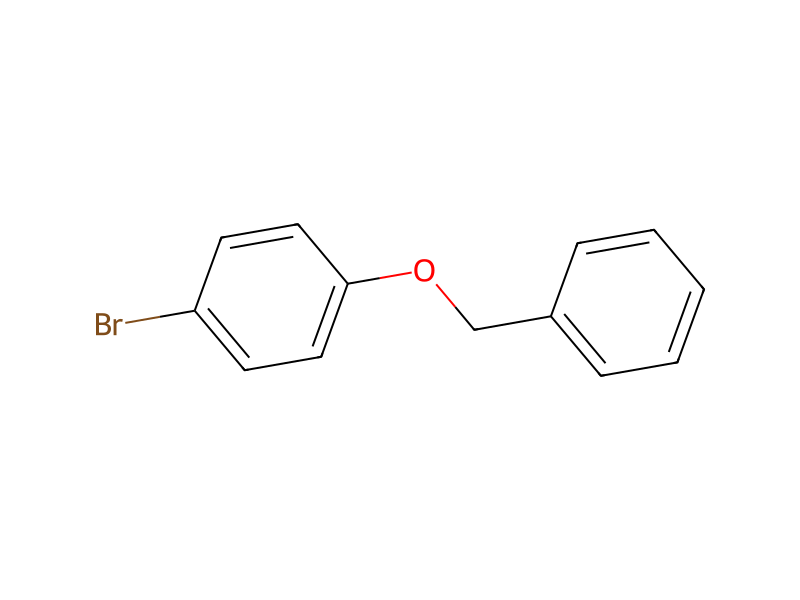
Benzyl Chloride → 1-Bromo-4-phenylmethoxybenzene
Reaction equation

[CH2:1](Cl)[C:2]1[CH:7]=[CH:6][CH:5]=[CH:4][CH:3]=1.[Br:9][C:10]1[CH:15]=[CH:14][C:13]([OH:16])=[CH:12][CH:11]=1.C(=O)([O-])[O-].[K+].[K+]>C(C(C)=O)C>[Br:9][C:10]1[CH:15]=[CH:14][C:13]([O:16][CH2:1][C:2]2[CH:7]=[CH:6][CH:5]=[CH:4][CH:3]=2)=[CH:12][CH:11]=1Participants
5
Reactant 3



Product 1
Reagents, catalysts & solvents 1

Procedure
First, 53.2 g of benzyl chloride, 69.2 g of 4-bromophenol, 110.4 g of potassium carbonate, and 800 ml of methyl ethyl ketone were put in a 2 flask, and stirred under reflux for 30 minutes. After the reaction, insoluble material was filtered off, and the solvent was distilled off from the filtrate. Ether and a 2% sodium hydroxide aqueous solution were added to the residue to separate an organic layer. The organic layer was washed with a saturated brine and dried with sodium sulfate. The solvent was then distilled off. The residue was distilled (b.p. 131° C. to 140° C./0.08 mmHg), to obtain 61.0 g (Y: 58.07%) of 4-bromo-1-benzyloxybenzene. The purity of the resultant compound was 99.0% as measured by GC.
Workup
- temperatureunder reflux for 30 minutes
- customAfter the reaction, insoluble material
- filtrationwas filtered off
- distillationthe solvent was distilled off from the filtrate
- additionEther and a 2% sodium hydroxide aqueous solution were added to the residue
- customto separate an organic layer
- washThe organic layer was washed with a saturated brine
- dry with materialdried with sodium sulfate
- distillationThe solvent was then distilled off
- distillationThe residue was distilled (b.p. 131° C. to 140° C./0.08 mmHg)
Sources & evidence
- ORD record
- ord-83ce407ac1ab4e07a1ccf674084f03f4
- Source dataset
- uspto-grants-2002_05
- Patent number
- US06388146B1
Reaction notes
Loading…