Morpholine → 3-Hydroxy-4-nitrobenzoic acid morpholide
Reaction equation

[OH:1][C:2]1[CH:3]=[C:4]([CH:8]=[CH:9][C:10]=1[N+:11]([O-:13])=[O:12])[C:5]([OH:7])=O.Cl.C(N=C=NCCCN(C)C)C.ON1C2C=CC=CC=2N=N1.[NH:36]1[CH2:41][CH2:40][O:39][CH2:38][CH2:37]1>CN(C)C=O.C(N(CC)CC)C>[OH:1][C:2]1[CH:3]=[C:4]([CH:8]=[CH:9][C:10]=1[N+:11]([O-:13])=[O:12])[C:5]([N:36]1[CH2:41][CH2:40][O:39][CH2:38][CH2:37]1)=[O:7]Participants
Reactant 4

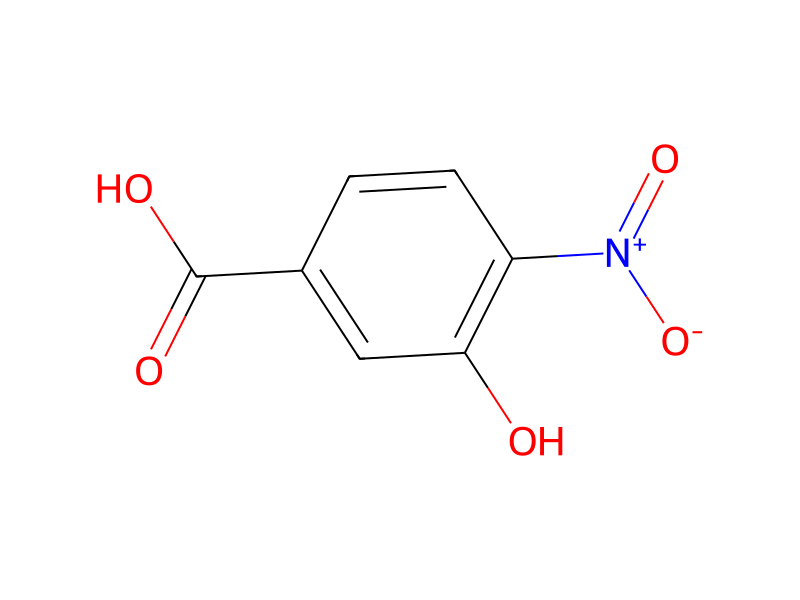


Product 1

Reagents, catalysts & solvents 2


Procedure
To a solution of 3-hydroxy-4-nitrobenzoic acid (10.00 g) in dry N,N-dimethylformamide (150 ml), 1-ethyl-3- (3-dimethylaminopropyl ) carbodiimide hydrochloride (12.56 g) , 1-hydroxybenzotriazole (8.86 g) , triethylamine (7.18 g) , and morpholine (5.71 g) were added successively. A mixture was stirred at room temperature for 23 hours, and the solvent was evaporated in a bath at 80° C. under reduced pressure to a solution volume of approximately 100 ml. Ethyl acetate (400 ml) was added to the residue, and the mixture was washed with 1N HCl aqueous solution (100 ml), water (200 ml), saturated sodium carbonate aqueous solution (50 ml), and water (150 ml). The organic layer was dried over anhydrous magnesium sulfate, and concentrated to obtain the compound ([3]-(32)-587) (7.89 g) as a yellow solid.
Workup
- customthe solvent was evaporated in a bath at 80° C. under reduced pressure to a solution volume of approximately 100 ml
- additionEthyl acetate (400 ml) was added to the residue
- washthe mixture was washed with 1N HCl aqueous solution (100 ml), water (200 ml), saturated sodium carbonate aqueous solution (50 ml), and water (150 ml)
- dry with materialThe organic layer was dried over anhydrous magnesium sulfate
- concentrationconcentrated
Sources & evidence
- ORD record
- ord-b641c062cc834bcb8f7043ab13229c58
- Source dataset
- uspto-grants-1997_12
- Patent number
- US05696118
Reaction notes
Loading…