4-Nitrobenzoic Acid → HCID 11774541, compound
Reaction equation

[CH2:1]([O:8][C@@H:9]([C@H:19]([C@@H:28]([CH2:30][O:31][CH2:32][C:33]1[CH:38]=[CH:37][CH:36]=[CH:35][CH:34]=1)[OH:29])[O:20][CH2:21][C:22]1[CH:27]=[CH:26][CH:25]=[CH:24][CH:23]=1)[CH2:10][O:11][Si](C(C)(C)C)(C)C)[C:2]1[CH:7]=[CH:6][CH:5]=[CH:4][CH:3]=1.[N+](C1C=CC(C(O)=O)=CC=1)([O-])=O.C1(P(C2C=CC=CC=2)C2C=CC=CC=2)C=CC=CC=1.CC(OC(/N=N/C(OC(C)C)=O)=O)C.[F-].C([N+](CCCC)(CCCC)CCCC)CCC>C1COCC1>[CH2:1]([O:8][C@H:9]([C@@H:19]([C@@H:28]([CH2:30][O:31][CH2:32][C:33]1[CH:34]=[CH:35][CH:36]=[CH:37][CH:38]=1)[OH:29])[O:20][CH2:21][C:22]1[CH:23]=[CH:24][CH:25]=[CH:26][CH:27]=1)[CH2:10][OH:11])[C:2]1[CH:7]=[CH:6][CH:5]=[CH:4][CH:3]=1Participants
Reactant 5




Product 1

Reagents, catalysts & solvents 1

Conditions
- Temperature
- 0 °C
Procedure
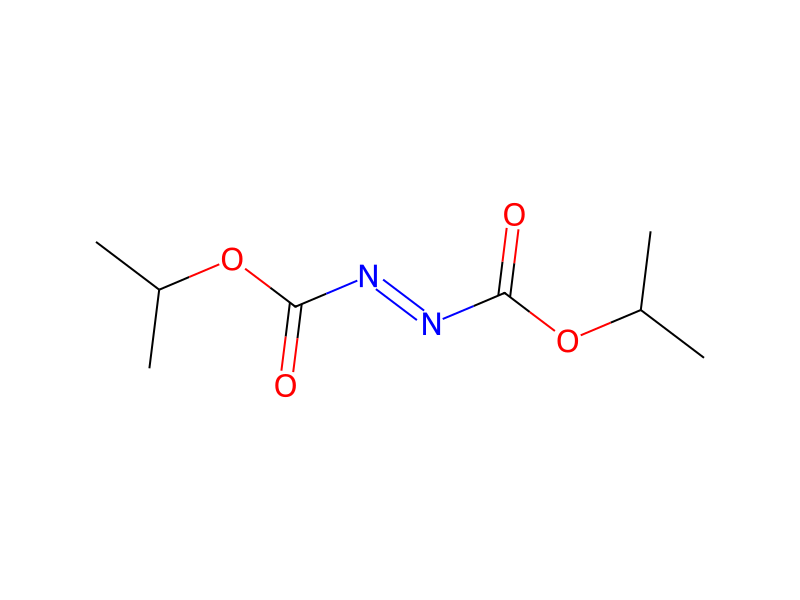
A solution of 240 (6.50 g, 12.1 mmol) in THF (60 mL) containing p-nitrobenzoic acid (4.06 g, 24.2 mmol) and triphenylphosphine (6.36 g, 24.2 mmol) was cooled to 0° C. A solution of diisopropylazodicarboxylate (4.8 mL, 24.2 mmol) in THF (30 mL) was added to the mixture over 2 h. After stirring for 20 h at ambient temperature, the reaction mixture was concentrated and then partitioned between Et2O (200 mL) and H2O (100 mL). The organic phase was washed with saturated aqueous NaHCO3 (3×50 mL), followed by brine (50 mL). The organic layer was dried over anhydrous Na2SO4 and concentrated under vacuum. The residue was dissolved in MeOH (50 mL) and 1N NaOMe/MeOH (1.0 mL) was added. The mixture was stirred at room temperature for 1 h and concentrated. The residue was partitioned between Et2O (150 mL) and H2O (100 mL). The organic layer was washed with brine (50 mL), dried over anhydrous Na2SO4, and concentrated. The residue was re-dissolved in THF (50 mL) and a solution of tetrabutylammonium fluoride (1M in THF, 13.0 mL, 13.0 mmol) was added. The mixture was stirred at room temperature for 1.5 h and partitioned between Et2O (150 mL) and H2O (50 mL). The organic layer was washed with brine (50 mL), dried over anhydrous Na2SO4, and concentrated. The crude product was purified by flash chromatography (hexanes:EtOAc, 4:1→1:1) to give a colorless oil 242 (2.80 g, 57%). See Ref. 100 for experimental data.
Workup
- concentrationthe reaction mixture was concentrated
- custompartitioned between Et2O (200 mL) and H2O (100 mL)
- washThe organic phase was washed with saturated aqueous NaHCO3 (3×50 mL)
- dry with materialThe organic layer was dried over anhydrous Na2SO4
- concentrationconcentrated under vacuum
- dissolutionThe residue was dissolved in MeOH (50 mL)
- addition1N NaOMe/MeOH (1.0 mL) was added
- stirringThe mixture was stirred at room temperature for 1 h
- concentrationconcentrated
- customThe residue was partitioned between Et2O (150 mL) and H2O (100 mL)
- washThe organic layer was washed with brine (50 mL)
- dry with materialdried over anhydrous Na2SO4
- concentrationconcentrated
- dissolutionThe residue was re-dissolved in THF (50 mL)
- stirringThe mixture was stirred at room temperature for 1.5 h
- custompartitioned between Et2O (150 mL) and H2O (50 mL)
- washThe organic layer was washed with brine (50 mL)
- dry with materialdried over anhydrous Na2SO4
- concentrationconcentrated
- customThe crude product was purified by flash chromatography (hexanes:EtOAc, 4:1→1:1)
Sources & evidence
- ORD record
- ord-f2ce8f2dcb5646edb893dc287ccba23f
- Source dataset
- uspto-grants-2013_03
- Patent number
- US08389565B2
Reaction notes
Loading…