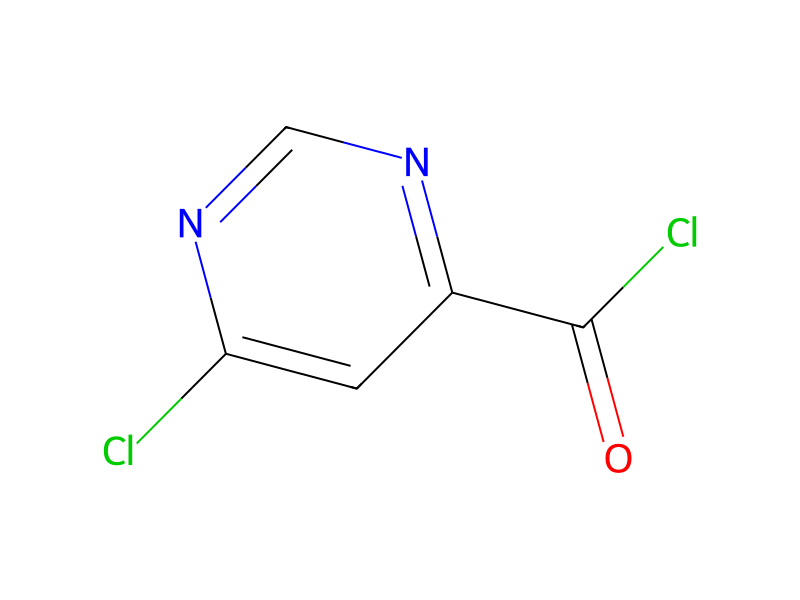
Phosphorus oxychloride → 6-Chloropyrimidine-4-carbonyl chloride
Reaction equation

O[C:2]1[N:7]=[CH:6][N:5]=C(C(O)=O)[CH:3]=1.P(Cl)(Cl)(Cl)(Cl)Cl.P(Cl)(Cl)([Cl:19])=O.[C:22](Cl)(=O)[C:23]([Cl:25])=[O:24]>ClCCl.CN(C=O)C>[Cl:19][C:2]1[N:7]=[CH:6][N:5]=[C:22]([C:23]([Cl:25])=[O:24])[CH:3]=1Participants






Conditions
- Temperature
- 0 °C
Procedure
A stirred mixture of 6-hydroxypyrimidine-4-carboxylic acid (10.0 g, 71.4 mmol, prepared according to the method described by Daves, G. C.; Baiocchi, F.; Robins, R. K.; Cheng, C. C. in J. Org. Chem. 1961, 26, 2755-2763) and phosphorus pentachloride (58.0 g, 0.27 mol) was treated with phosphorus oxychloride (100 mL, 1.07 mol) and the resultant mixture was refluxed for 16 hours under nitrogen. The excess phosphorus oxychloride was distilled off and the residue was azeotroped three times with toluene and dried in vacuo. The solid product obtained was suspended in dry dichloromethane (100 mL), cooled (0° C.) and treated with dry DMF (2 mL) and oxalyl chloride (7.9 mL, 91 mmol). The resultant mixture was stirred at room temperature for 15 hours and evaporated in vacuo to afford 6-chloropyrimidine-4carbonyl chloride as a brown liquid, which was used for the next step.
Workup
- customprepared
- distillationThe excess phosphorus oxychloride was distilled off
- customthe residue was azeotroped three times with toluene
- customdried in vacuo
- customThe solid product obtained
- customevaporated in vacuo
Sources & evidence
- ORD record
- ord-c5cbdabdf2264bed9a6b5f84ca607ddc
- Source dataset
- uspto-grants-2013_03
- Patent number
- US08399448B2
Reaction notes
Loading…