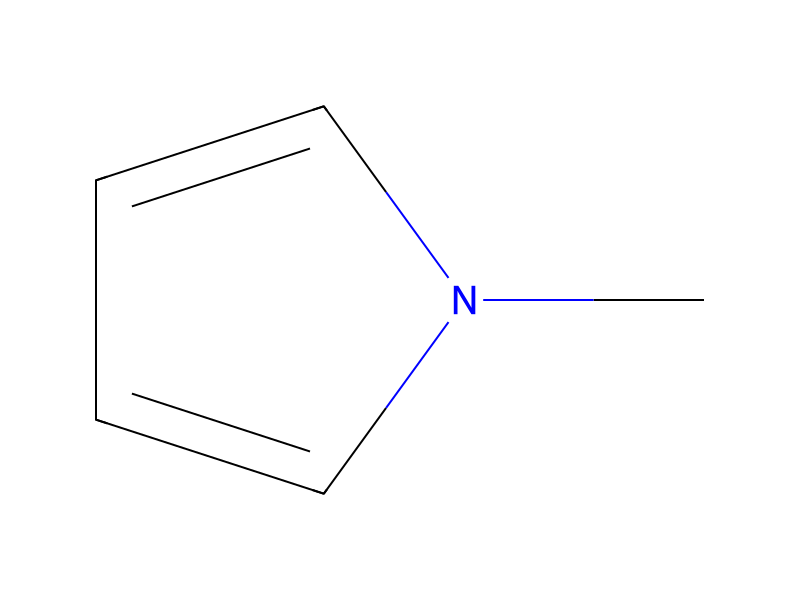
1-Methylpyrrole → HCID 12914969, compound
Reaction equation

CN1C=CC=C1.[C:7]([C:9]1[N:10]([CH3:14])[CH:11]=[CH:12][CH:13]=1)#[N:8].ClS(N=[C:20]=[O:21])(=O)=O.C(NC(C)C)(C)C.C([Li])CCC.CCCCCC.O.C(O)(=O)CC(CC(O)=O)(C(O)=O)O>C(#N)C.C1COCC1.O.CN(C)C=O>[C:7]([C:9]1[N:10]([CH3:14])[C:11]([CH:20]=[O:21])=[CH:12][CH:13]=1)#[N:8]Participants
Reactant 7





Product 1

Reagents, catalysts & solvents 4




Conditions
- Temperature
- -20 °C
Procedure
1-methylpyrrole can be converted into 2-cyano-1-methylpyrrole by reaction with chlorosulfonyl isocyanate and dimethylformamide in acetonitrile (see, for example, C. E. Loader et al. Can. J. Chem. 59, (1981) 2673-6). Diisopropylamine (17.5 ml, 124.38 mmol) was introduced into THF (100 ml) under nitrogen. At -78° C., n-butyllithium solution in hexane (15% strength, 75.9 ml, 124.38 mmol) was added dropwise. The mixture was then stirred at -20° C. for 45 min and subsequently cooled to -78° C. again, at which temperature a solution of N-methylpyrrole-2-carbonitrile (12 g, 113.07 mmol) in THF (50 ml) was added dropwise. After stirring at -78° C. for 45 min, DMF (43.9 ml, 546.46 mmol) was added dropwise and stirring was continued at this temperature for 2 h. Addition of citric acid monohydrate (20.56 g) was followed by warming to room temperature and addition of water (112 ml). The THF was removed in a rotary evaporator, and the aqueous phase was saturated with sodium chloride and extracted with diethyl ether (3×200 ml). The combined organic phases were washed with saturated sodium chloride solution and dried over sodium sulfate. The solvent was removed in a rotary evaporator, and the crude product was purified by flash chromatography (silica gel, dichloromethane). Yield: 8.25 g (54%). 1H-NMR (CDCl3) δ=4.1 (s, 3H), 6.8 (d, 1H), 6.9 (d, 1H), 9.7 (s, 1H).
Workup
- temperaturesubsequently cooled to -78° C. again
- stirringAfter stirring at -78° C. for 45 min
- stirringstirring
- waitwas continued at this temperature for 2 h
- temperatureby warming to room temperature
- customThe THF was removed in a rotary evaporator
- extractionextracted with diethyl ether (3×200 ml)
- washThe combined organic phases were washed with saturated sodium chloride solution
- dry with materialdried over sodium sulfate
- customThe solvent was removed in a rotary evaporator
- customthe crude product was purified by flash chromatography (silica gel, dichloromethane)
Sources & evidence
- ORD record
- ord-30fd9d5f6e104d57b27a3cd633764211
- Source dataset
- uspto-grants-2000_09
- Patent number
- US06114358
Reaction notes
Loading…