Triphenylphosphine → 3-(4-Methylphenyl)benzonitrile
Reaction equation

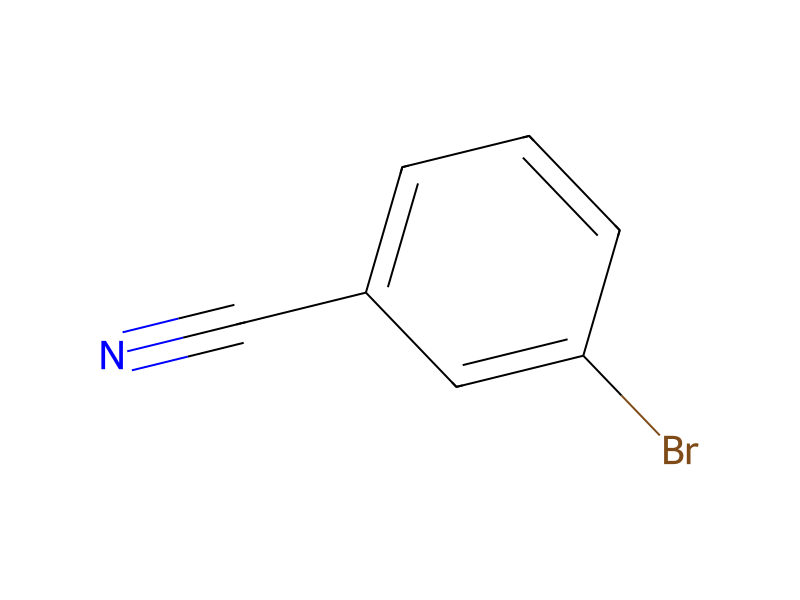
[CH3:1][C:2]1[CH:7]=[CH:6][C:5]([Mg]Cl)=[CH:4][CH:3]=1.Br[C:11]1[CH:12]=[C:13]([CH:16]=[CH:17][CH:18]=1)[C:14]#[N:15].C1(P(C2C=CC=CC=2)C2C=CC=CC=2)C=CC=CC=1>O1CCCC1.C([O-])(=O)C.[Pd+2].C([O-])(=O)C>[CH3:1][C:2]1[CH:7]=[CH:6][C:5]([C:11]2[CH:18]=[CH:17][CH:16]=[C:13]([C:14]#[N:15])[CH:12]=2)=[CH:4][CH:3]=1Participants
6





Procedure
4-methylphenylmagnesium chloride (49 g, 20% solution in tetrahydrofuran) is added dropwise over eight hours to a refluxing solution of 3-bromobenzonitrile (10 g), palladium (II) acetate (2.4 g) and triphenylphosphine (5.8 g) in tetrahydrofuran (200 ml). [HPLC: yield 89-91%]. After cooling to room temperature tetrahydrofuran is removed under vacuum. The residue is taken up in toluene/water (3:1) (200 ml ) and the aqueous phase separated off. The solvent is removed by distillation and the crude product purified by column chromatrography (Kieselgel 60; n-hezane/acetone 3:1) to give 4'-methylbiphenyl-3-carbonitrile as a solid, m.pt. 59-61° C. 1H NMR (CDCl3): 2.41(s,3H), 7.29(d,2H), 7.46(d,2H), 7.49-7.63(m,2H) 7.77-7.85(m,2H).
Workup
- customis removed under vacuum
- customthe aqueous phase separated off
- customThe solvent is removed by distillation
- customthe crude product purified by column chromatrography (Kieselgel 60; n-hezane/acetone 3:1)
Sources & evidence
- ORD record
- ord-cf7603185a594b088e17346efaff9279
- Source dataset
- uspto-grants-2000_09
- Patent number
- US06121480
Reaction notes
Loading…