Hydrochloric Acid → 2-(1-(Ethylsulfonyl)azetidin-3-ylidene)acetonitrile
Reaction equation

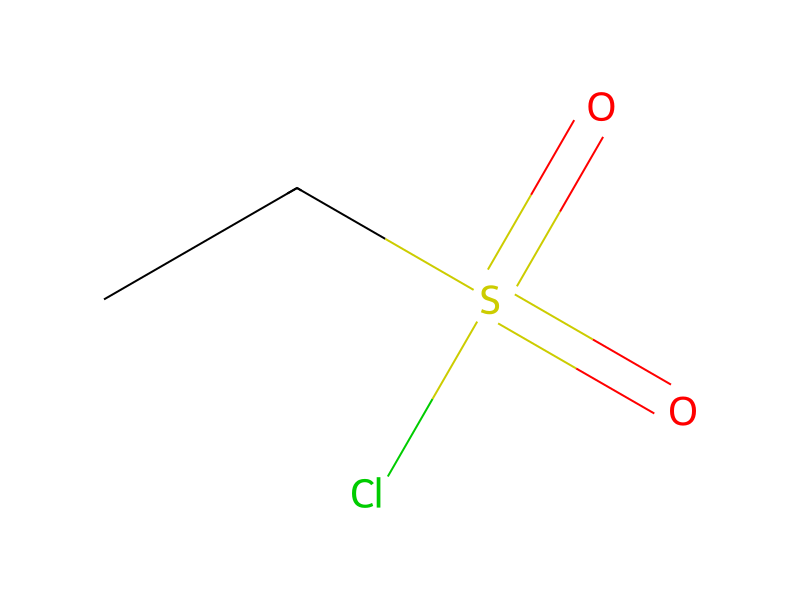
[C:1]([CH:3]=[C:4]1[CH2:7][N:6](C(OC(C)(C)C)=O)[CH2:5]1)#[N:2].Cl.C(N(C(C)C)CC)(C)C.[CH2:25]([S:27](Cl)(=[O:29])=[O:28])[CH3:26]>C(#N)C>[CH2:25]([S:27]([N:6]1[CH2:5][C:4](=[CH:3][C:1]#[N:2])[CH2:7]1)(=[O:29])=[O:28])[CH3:26]Participants
Reactant 4



Product 1

Reagents, catalysts & solvents 1

Conditions
- Temperature
- 2.5 °C
Procedure
A solution of tert-butyl 3-(cyanomethylene)azetidine-1-carboxylate (9, 1000 g, 5.2 mol) in acetonitrile (7 L) and a 3 N aqueous HCl solution (7 L) was stirred at room temperature for 18 h. When HPLC showed that all the starting material (9) was consumed, the reaction mixture was concentrated under reduced pressure to dryness. The residue, which contains the crude desired deprotection product (10), was then suspended in acetonitrile (12 L) and the resulting suspension was cooled to 0-5° C. Diisopropyethylamine (DIEA, 3.14 L, 18.03 mol, 3.5 equiv) was then slowly added while keeping the internal temperature below 5° C. The resulting homogeneous solution was allowed to cool down to 0° C. and ethane sulfonyl chloride (EtSO2Cl, 730 mL, 7.73 mol, 1.5 equiv) was added over 1 h while keeping the internal temperature below 5° C. The resulting reaction mixture was allowed to gradually warm to room temperature and stirred at room temperature for overnight. When HPLC showed that the reaction was complete, the reaction mixture was concentrated under reduced pressure to a volume of approximately 2 L. The bath temperature of the rotary evaporator is set to not exceed 45° C. The concentrated residue was then diluted with dichloromethane (CH2Cl2, 10 L) and the resulting dichloromethane solution was washed with aqueous sodium chloride solution (10 L). The aqueous phase was back extracted with dichloromethane (CH2Cl2, 5 L). The combined organic layers were dried over anhydrous sodium sulfate (Na2SO4) and the residue was absorbed onto silica gel (SiO2, 1 Kg) under reduced pressure. The bath temperature of the rotary evaporator was set to not exceed 45° C. The material was then loaded onto a silica gel column (SiO2, 2.5 Kg) and eluted with 20-60% ethyl acetate in heptane to afford 2-(1-(ethylsulfonyl)azetidin-3-ylidene)acetonitrile (11, 882 g, 968.4 g theoretical, 91% yield) as off-white solids. For 11: 1H NMR (CDCl3, 300 MHz) δ 5.46 (m, 1H), 4.77 (m, 2H), 4.70 (m, 2H), 3.05 (q, 2H), 1.39 (t, 3H) ppm; C7H10N2O2S (MW, 186.23), LCMS (EI) m/e 187 (M++H).
Workup
- customwas consumed
- concentrationthe reaction mixture was concentrated under reduced pressure to dryness
- customthe internal temperature below 5° C
- temperatureto cool down to 0° C.
- customthe internal temperature below 5° C
- customThe resulting reaction mixture
- temperatureto gradually warm to room temperature
- concentrationthe reaction mixture was concentrated under reduced pressure to a volume of approximately 2 L
- customThe bath temperature of the rotary evaporator
- customexceed 45° C
- additionThe concentrated residue was then diluted with dichloromethane (CH2Cl2, 10 L)
- washthe resulting dichloromethane solution was washed with aqueous sodium chloride solution (10 L)
- extractionThe aqueous phase was back extracted with dichloromethane (CH2Cl2, 5 L)
- dry with materialThe combined organic layers were dried over anhydrous sodium sulfate (Na2SO4)
- customthe residue was absorbed onto silica gel (SiO2, 1 Kg) under reduced pressure
- customThe bath temperature of the rotary evaporator
- customexceed 45° C
- washeluted with 20-60% ethyl acetate in heptane
Sources & evidence
- ORD record
- ord-98c4c33d49cc42cf8c6440cdbf38b3a2
- Source dataset
- uspto-grants-2013_04
- Patent number
- US08420629B2
Reaction notes
Loading…