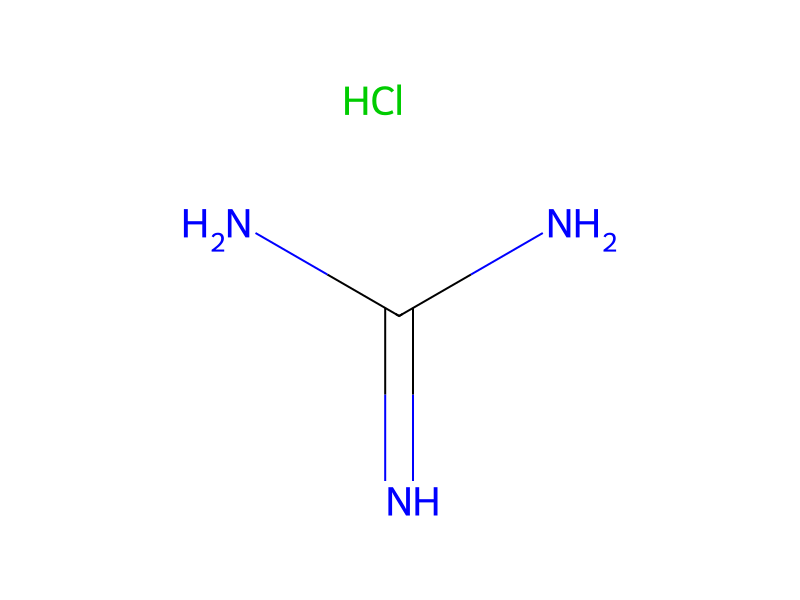
Guanidine Hydrochloride → HCID 86627578, compound
Reaction equation

Cl.[NH2:2][C:3]([NH2:5])=[NH:4].CN(C)[CH:8]=[CH:9][C:10]([C:12]1[CH:21]=[CH:20][C:19]2[NH:18][C:17](=[O:22])[C:16]3[NH:23][CH:24]=[CH:25][C:15]=3[C:14]=2[CH:13]=1)=O.[CH2:27]([C:29]([O-:31])=[O:30])[CH3:28]>CC(N(C)C)=O>[NH2:4][C:3]1[N:5]=[C:10]([C:12]2[CH:21]=[CH:20][C:19]3[NH:18][C:17](=[O:22])[C:16]4[NH:23][CH:24]=[CH:25][C:15]=4[C:14]=3[CH:13]=2)[CH:9]=[CH:8][N:2]=1.[CH2:27]([C:29]([O-:31])=[O:30])[CH3:28]Participants
4
Reactant 2

Product 1

Reagents, catalysts & solvents 1

Conditions
- Temperature
- 130 °C
Procedure
83 mg (0.87 mmol) of guanidine hydrochloride is added to a suspension of 204 mg (0.58 mmol) of 8-(3-dimethylamino-acryloyl)-4-oxo-4,5-dihydro-3H-pyrrolo[2,3-c]quinoline-1-ethyl carboxylate in 2.3 mL of anhydrous dimethylacetamide. The mixture is stirred at 130° C. for 4 days then the solvent is evaporated. The residue is triturated with methanol to give a solid which is collected by filtration then washed with methanol and then diisopropyl ether. After drying, 114 mg (56%) of 8-(2-amino-pyrimidin-4-yl)-4-oxo-4,5-dihydro-3H-pyrrolo[2,3-c]quinoline-1-ethyl carboxylate is obtained in the form of a brown solid.
Workup
- customthe solvent is evaporated
- customThe residue is triturated with methanol
- customto give a solid which
- filtrationis collected by filtration
- washthen washed with methanol
- customAfter drying
Sources & evidence
- ORD record
- ord-f4501c6337aa49aeaf88ac06cd7e379f
- Source dataset
- uspto-grants-2013_04
- Patent number
- US08426437B2
Reaction notes
Loading…