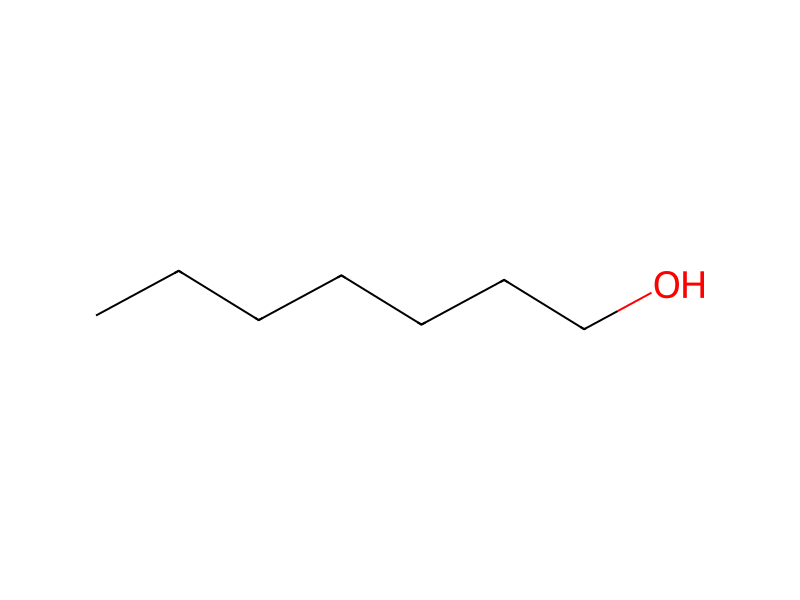
Heptanol → 6-(Heptyloxy)-7H-purine
Reaction equation

[CH2:1]([OH:8])[CH2:2][CH2:3][CH2:4][CH2:5][CH2:6][CH3:7].[H-].[Na+].Cl[C:12]1[N:20]=[CH:19][N:18]=[C:17]2[C:13]=1[NH:14][CH:15]=[N:16]2>O1CCCC1>[CH2:1]([O:8][C:12]1[N:20]=[CH:19][N:18]=[C:17]2[C:13]=1[NH:14][CH:15]=[N:16]2)[CH2:2][CH2:3][CH2:4][CH2:5][CH2:6][CH3:7]Participants
Reactant 3


Product 1

Reagents, catalysts & solvents 1

Procedure
Heptanol (45.02 g, 0.388 mol) was added to a stirred suspension of a 60% dispersion of sodium hydride in oil (16.62 g, 0.416 mol) in dry tetrahydrofuran (350 ml) under an atmosphere of nitrogen. After gas evolution had ceased (about 1 h), 6-chloropurine (16.04 g, 0.104 mol) was added. The reaction began to foam and more gas was evolved. When gas evolution had ceased (about 0.75 h) the reaction was heated at reflux for 3 h then the solvent was removed in vacuo. The residual oily solid was suspended in water (2l) then concentrated hydrochloric acid (30 ml) was added. The aqueous suspension was neutralised with saturated sodium hydrogen carbonate solution and 60-80 petroleum ether (750 ml) added. The solid was moved from the biphasic mixture by filtration, washed with 60-80 petroleum ether and dried at oil-pump vacuum/40° C. This gave the title compound (1)(18.64 g, 79.7 mmol, 77%) as a white solid.
Workup
- additionwas added
- custom(about 0.75 h)
- temperaturewas heated
- temperatureat reflux for 3 h
- customthe solvent was removed in vacuo
- additionconcentrated hydrochloric acid (30 ml) was added
- additionadded
- filtrationThe solid was moved from the biphasic mixture by filtration
- washwashed with 60-80 petroleum ether
- customdried at oil-pump vacuum/40° C
Sources & evidence
- ORD record
- ord-dd07a41a1d854c7c9cdf2e59c3f4cd80
- Source dataset
- uspto-grants-2001_05
- Patent number
- US06238855B1
Reaction notes
Loading…