Pivalic acid → 7-Amino-3-(5-methyl-1,3,4-thiadiazol-2-yl)thiomethyl-3-cephem-4-carboxylic acid
Reaction equation

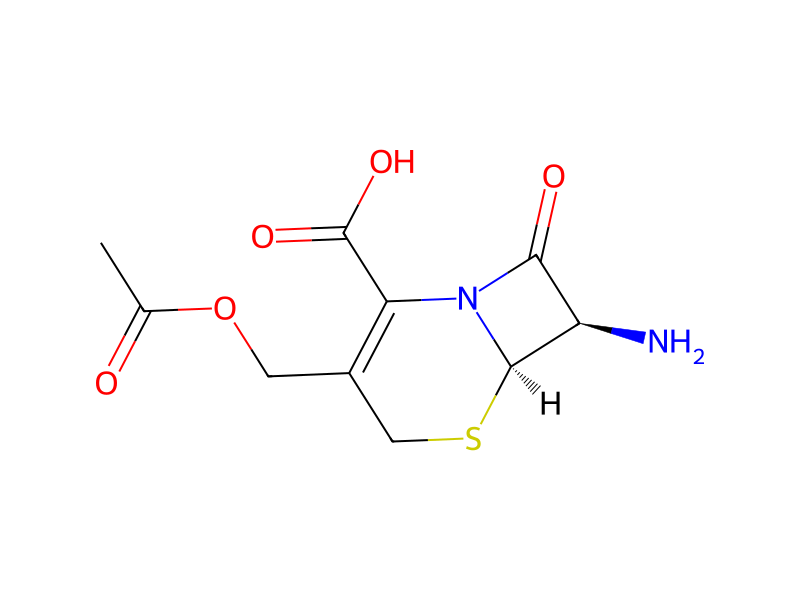
[CH3:1][C:2]1[S:6][C:5]([SH:7])=[N:4][N:3]=1.C(N(CC)CC)C.C(O)(=O)C(C)(C)C.CC(O[CH2:26][C:27]1[CH2:36][S:35][C@@H:30]2[C@H:31]([NH2:34])[C:32](=[O:33])[N:29]2[C:28]=1[C:37]([OH:39])=[O:38])=O>O>[NH2:34][CH:31]1[C:32](=[O:33])[N:29]2[C:28]([C:37]([OH:39])=[O:38])=[C:27]([CH2:26][S:7][C:5]3[S:6][C:2]([CH3:1])=[N:3][N:4]=3)[CH2:36][S:35][C@H:30]12Participants





Conditions
- Temperature
- 82 °C
Procedure
A mixture of 30 g of 5-methyl-2-mercapto,1,3,4-thiadiazole, 32 ml of triethylamine and 5 g of pivalic acid in 2 liters of water was heated to 82° C. Thereafter there was added in one shot 40 g of 7-aminocephalosporanic acid (92%) and 5 g of pivalic acid were added in one shot to the resulting solution. Precipitation started after a few minutes and increased with time. After 30 minutes of vigorous stirring at the same temperature, the mixture was cooled to 65° C. The solid was isolated by filtering, washed with water and acetone to give 35 g of the compound of the title. The liquors were cooled to 20° C. and filtered and gave a further 5 g fraction, with an overall yield of 87%. The infrared and proton magnetic resonance spectra are consistent with the technically pure product.
Workup
- additionThereafter there was added in one
- additionwere added in one shot to the resulting solution
- customPrecipitation
- waitstarted after a few minutes
- temperatureincreased with time
- temperaturethe mixture was cooled to 65° C
- customThe solid was isolated
- filtrationby filtering
- washwashed with water and acetone
Sources & evidence
- ORD record
- ord-f9055f872f1c493e8e1cbf9bf3c4439c
- Source dataset
- uspto-grants-1984_11
- Patent number
- US04481357
Reaction notes
Loading…