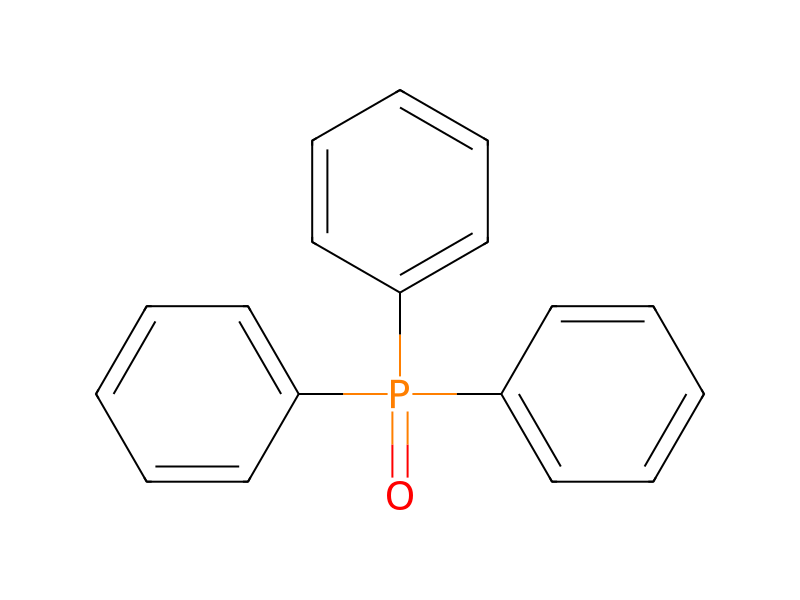
Sodium Hydroxide → Triphenylphosphine Oxide
Reaction equation

[C:1]1([P:7](=S)([C:14]2[CH:19]=[CH:18][CH:17]=[CH:16][CH:15]=2)[C:8]2[CH:13]=[CH:12][CH:11]=[CH:10][CH:9]=2)[CH:6]=[CH:5][CH:4]=[CH:3][CH:2]=1.[OH-:21].[Na+]>C(O)C(C)C>[C:1]1([P:7](=[O:21])([C:14]2[CH:19]=[CH:18][CH:17]=[CH:16][CH:15]=2)[C:8]2[CH:13]=[CH:12][CH:11]=[CH:10][CH:9]=2)[CH:6]=[CH:5][CH:4]=[CH:3][CH:2]=1Participants
4
Reactant 2


Product 1
Reagents, catalysts & solvents 1

Procedure
To a mixture of isobutanol (50 ml), triphenylphosphine sulfide (7.0 g) and aqueous 5% sodium hydroxide (50 ml) is bubbled chlorine gas at 15° C. until no appreciable amount of the starting sulfide is detected on thin-layer chromatogram. The reaction mixture is allowed to stand for a while and the organic layer is taken. The layer is washed with water and concentrated to dryness. The residue is triturated with ether to give triphenylphosphine oxide.
Workup
- customis bubbled chlorine gas at 15° C. until no appreciable amount of the starting sulfide
- washThe layer is washed with water
- concentrationconcentrated to dryness
- customThe residue is triturated with ether
Sources & evidence
- ORD record
- ord-2f557de74e6549deac7ee1bd7b7f6940
- Source dataset
- uspto-grants-1985_04
- Patent number
- US04511738
Reaction notes
Loading…