Benzene → Mandelic Acid
Reaction equation

C([OH:4])(C)C.[CH2:5]([OH:8])[CH2:6][CH3:7].[CH2:9]([OH:11])C.[CH:12]1C=C[CH:15]=[CH:14][CH:13]=1>C1(C)C=CC=CC=1>[C:9]([OH:11])(=[O:4])[CH:5]([C:6]1[CH:15]=[CH:14][CH:13]=[CH:12][CH:7]=1)[OH:8]Participants
Reactant 4




Product 1
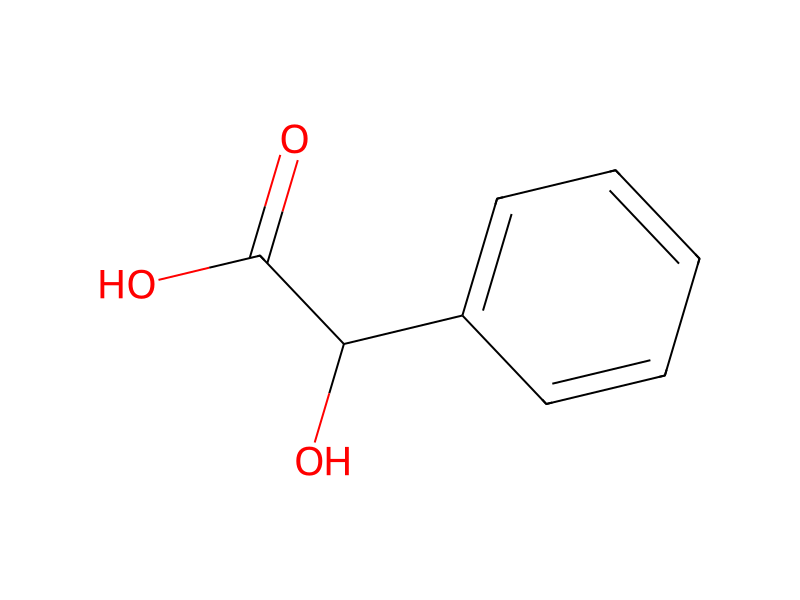
Reagents, catalysts & solvents 1

Procedure
The hydrogenation reaction preferably takes place in the presence of a solvent which is inert to the reactants, for example, isopropyl alcohol, n-propyl alcohol, ethanol, benzene and toluene. At the end of the reaction, the reaction mass is filtered, stripped of solvent and distilled as by fractional distillation. If desired, the reaction product defined according to the structure: ##STR35## may be used as is for its organoleptic properties or it may be further purified by means of standard "d" and "1" separation, for example, by producing esters from optically active acids such as d or 1 mandelic acid, separating the resulting stereoisomers by means of fractional crystalization and then hydrolyzing the resulting esters back to the alcohols defined according to the structures: ##STR36##
Workup
- customThe hydrogenation reaction preferably takes place in the presence of a solvent which
- customAt the end of the reaction
- filtrationthe reaction mass is filtered
- distillationdistilled as by fractional distillation
Sources & evidence
- ORD record
- ord-904ca41660254df9b0150e414eab20ce
- Source dataset
- uspto-grants-1985_04
- Patent number
- US04512918
Reaction notes
Loading…