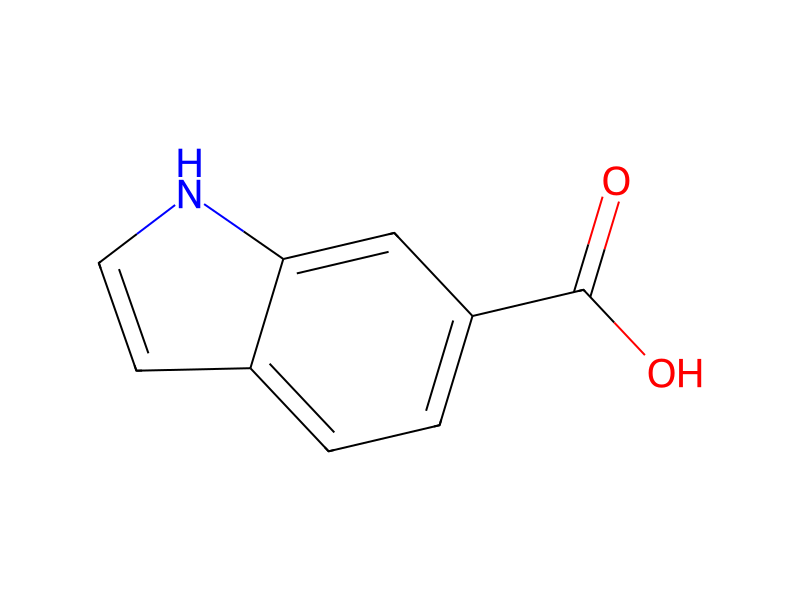
Hydrochloric Acid → 1H-indole-6-carboxylic acid
Reaction equation

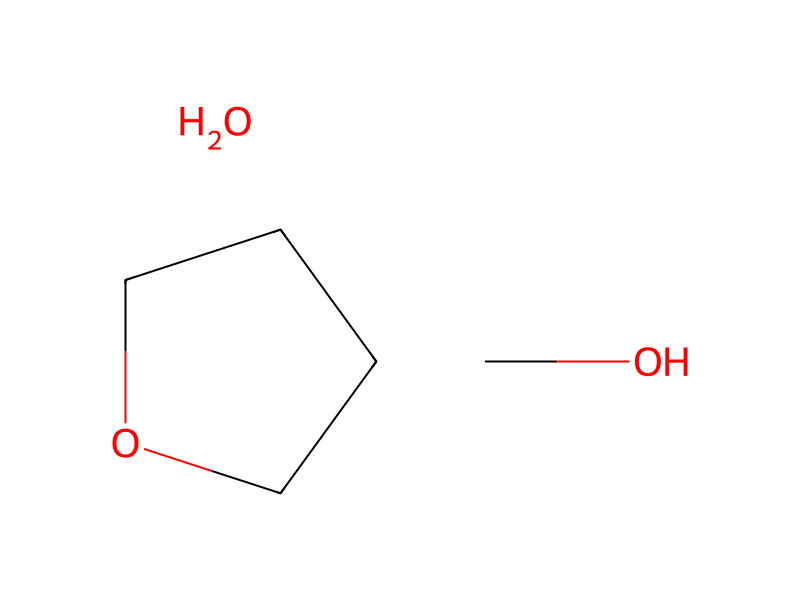
Br[C:2]1[NH:3][C:4]2[C:9]([C:10]=1C1CCCCC1)=[CH:8][CH:7]=[C:6]([C:17]([O:19]C)=[O:18])[CH:5]=2.O[Li].O.Cl.C1COCC1>CO.C1COCC1.O.O>[NH:3]1[C:4]2[C:9](=[CH:8][CH:7]=[C:6]([C:17]([OH:19])=[O:18])[CH:5]=2)[CH:10]=[CH:2]1Participants
Reactant 4




Product 1
Reagents, catalysts & solvents 2

Conditions
- Temperature
- 2 °C
Procedure
A solution of methyl 2-bromo-3-cyclohexyl-1H-indole-6-carboxylate (117 g, 349 mmol) and LiOH.H2O (26.4 g, 629 mmol) in MeOH/THF/H2O (1:1:1, 1.8 L) was heated at reflux for 3 h. The reaction mixture was cooled in an ice/H2O bath to 2° C., neutralized with 1M HCl (˜650 mL) (added at such a rate that temperature did not exceed 5° C.), diluted with H2O (1 L) and stirred while warming to ambient temperature. The precipitates were collected by filtration rinsed with H2O and dried to yield the mono THF solvate of 1H-indole-6-carboxylic acid, 2-bromo-3-cyclohexyl- (135.5 g, 345 mmol, 99%) as a yellow solid, which was used without further purification. 1HNMR (300 MHz, CDCl3) δ 11.01 (br s, 1H), 8.77 (s, 1H), 8.07 (d, J=1.5 Hz, 1H), 7.82 (dd, J=1.5, 8.8 Hz, 1H), 7.72 (d, J=8.8 Hz, 1H), 3.84-3.74 (m, 4H), 2.89 (m, 1H), 1.98-1.72 (m, 11H), 1.50-1.24 (m, 3H). 13CNMR (75 MHz, CDCl3) δ 172.7, 135.5, 130.7, 122.3, 120.9(2), 118.8, 113.3, 111.1, 67.9(2), 37.0, 32.2(2), 27.0 (2), 26.1, 25.5(2). LCMS: m/e 320 (M−H)−, ret time 2.21 min, column A, 4 minute gradient.
Workup
- temperatureat reflux for 3 h
- additionadded at such a rate that temperature
- customdid not exceed 5° C.
- temperaturewhile warming to ambient temperature
- filtrationThe precipitates were collected by filtration
- washrinsed with H2O
- customdried
Sources & evidence
- ORD record
- ord-07344b1bf1494dc7aacc1d9b67ffd132
- Source dataset
- uspto-grants-2009_06
- Patent number
- US07541351B2
Reaction notes
Loading…