Boron trifluoride → 2-(5-Iodo-1H-indol-3-yl)-N,N-dimethylethanamine
Reaction equation

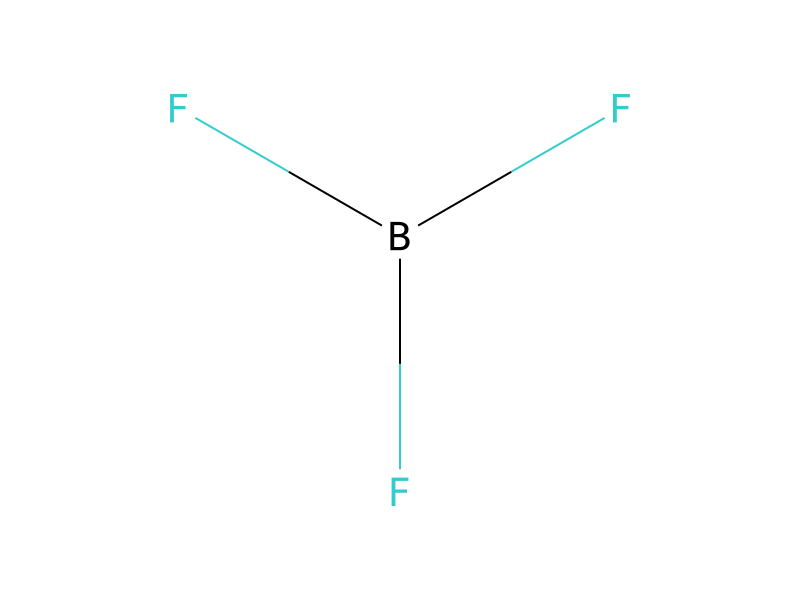
[I:1][C:2]1[CH:3]=[C:4]2[C:8](=[CH:9][CH:10]=1)[NH:7][C:6](=O)[C:5]2([CH2:13][C:14]([N:16]([CH3:18])[CH3:17])=O)O.[BH4-].[Na+].B(F)(F)F.[OH-].[Na+].C1N2CCN(CC2)C1>C1(C)C=CC=CC=1.O.COCCOC>[I:1][C:2]1[CH:3]=[C:4]2[C:8](=[CH:9][CH:10]=1)[NH:7][CH:6]=[C:5]2[CH2:13][CH2:14][N:16]([CH3:17])[CH3:18]Participants
Reactant 5


Product 1

Reagents, catalysts & solvents 3
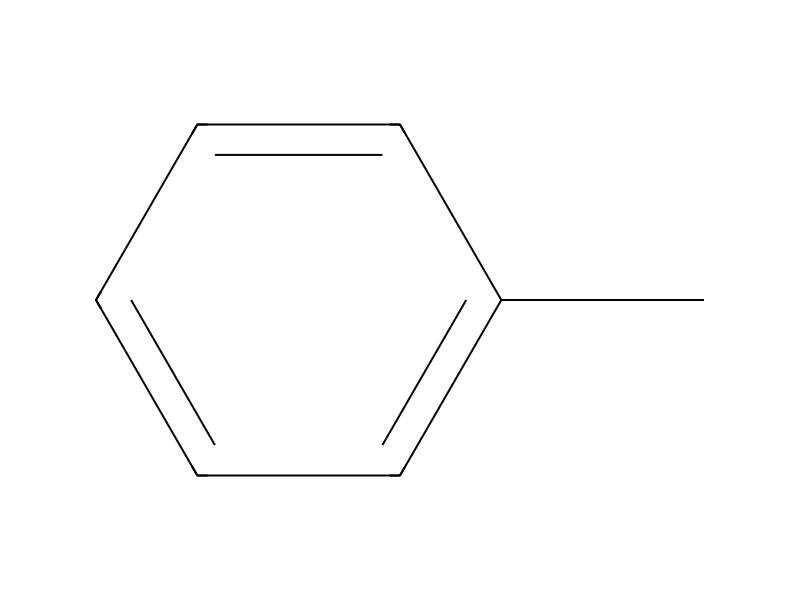
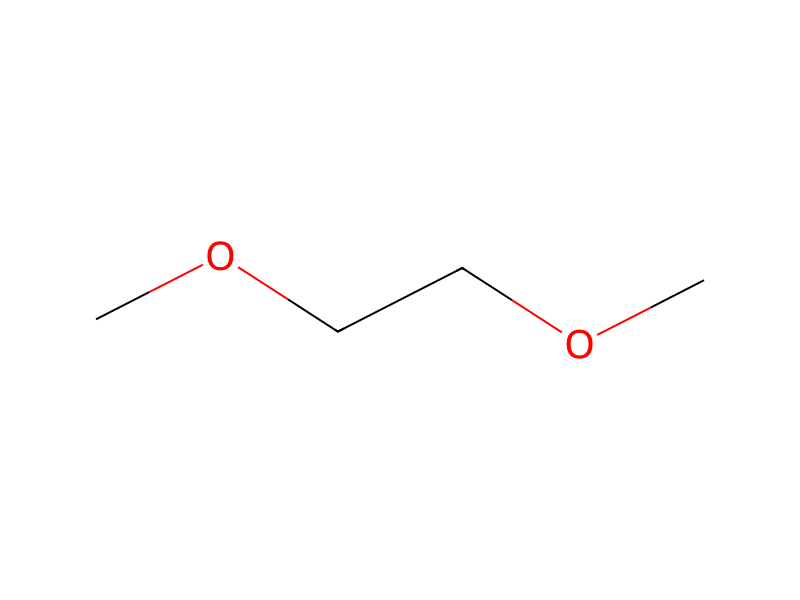
Conditions
- Temperature
- -15 °C
Procedure
A 3 L flask is charged with 2-(5-iodo-3-hydroxy-2-oxo-2,3-dihydro-1H-indol-3-yl)-N,N-dimethyl-acetamide (Example 6) (100 g, 0.277 mol), and 800 mL of DME. The supension is cooled to −15° C., and sodium borohydride (31.5 g 96%, 0.832 mol) is added to this mixture, which causes a raise of the temperature by 5C. To this, BF3-etherate is added dropwise during 30 minutes (157.6 g, 1.11 mol). Initially there is a strong exothermic reaction (requires slow addition of BF3-etherate) and evolution of a gas. The temperatureis maintained between −15 and −10° C. during the addition. The formed orange slurry is then allowed to warm slowly to ambient temperature (25-27° C.), and left stirring over night (17 h). To this mixture, then 4N NaOH (555 mL) is added and the mixture is heated under reflux for 50 minutes. Then DABCO (34.3 g) is added, and refluxing the mixture is continued for two additional hours. Then water (250 mL) is added, and the DME is removed on the rotavapor. The obtained orange slurry is then extracted with TBME (1000 mL, 2×600 mL), and the combined organic layers are washed with water (800 mL) and brine (700 mL), and concentrated on the rotavapor to about 600 mL. To the stirred residue, MnO2 (72.4 g), is added, and the exothermic oxidation causes a temperature rise of 20° C. Stirring is continued for one hour, and then the MnO2 is filtered off. Removal of the solvent from the filtrate gives a brown oil, which is dissolved in toluene. The toluene is extracted for three times with 4 N HCl (300 mL, 2×150 mL). After adjustment of the pH of the combined aqueous layers to about 10, the product is re-extracted with TBME (3×700 mL). The combined organic layers are washed with water (500 mL), and brine (500 mL), and after almost complete removal of the solvent on the rotavapor and standing over night at 4° C. some of the product crystallizes (39 g, 44.7%). Further concentration of the mother liquors and standing for two additional days gives another crop of the title product (9.5 g, 10.9%), while still about 20 g of material (about 22%) remains in the mother liquors. 1H-NMR (CDCl3, 300 MHz): δ 2.34 (s, 6H, NMe2); 2.59-2.66 (m, 2H, CH2NMe2); 2.85-2.92 (m, 2H, ArCH2); 6.90 (d, 1H, 3J=2.2 Hz, H-2); 7.03 (d, 1H, 3J=8.4 Hz, H-7); 7.38 (dd, 1H, 4J=1.3 Hz, H-6); 7.91 (d, 1H, H-4); 8.56 (br s, 1H, NH). 13C-NMR (CDCl3-D6, 75 MHz) δ 23.71 (ArCH2); 45.65 (N(CH3)2); 60.32 (CH2NMe2); 82.77 (C-5); 113.36 (C-6); 113.86 (C-3); 122.78 (C-2); 127.87 (C-4); 130.29 (C-7); 130.33 (C-8); 135.62 (C-9).
Workup
- temperatureThe temperatureis maintained between −15 and −10° C. during the addition
- temperatureto warm slowly to ambient temperature (25-27° C.)
- waitleft
- temperaturethe mixture is heated
- temperatureunder reflux for 50 minutes
- temperaturerefluxing the mixture
- customthe DME is removed on the rotavapor
- extractionThe obtained orange slurry is then extracted with TBME (1000 mL, 2×600 mL)
- washthe combined organic layers are washed with water (800 mL) and brine (700 mL)
- concentrationconcentrated on the rotavapor to about 600 mL
- additionTo the stirred residue, MnO2 (72.4 g), is added
- customa temperature rise of 20° C
- stirringStirring
- waitis continued for one hour
- filtrationthe MnO2 is filtered off
- customRemoval of the solvent from the filtrate
- customgives a brown oil, which
- extractionThe toluene is extracted for three times with 4 N HCl (300 mL, 2×150 mL)
- extractionAfter adjustment of the pH of the combined aqueous layers to about 10, the product is re-extracted with TBME (3×700 mL)
- washThe combined organic layers are washed with water (500 mL), and brine (500 mL)
- customafter almost complete removal of the solvent on the rotavapor
- waitstanding over night at 4° C.
- customsome of the product crystallizes (39 g, 44.7%)
Sources & evidence
- ORD record
- ord-1a05d64e74cb49b2835aa3e78b71b834
- Source dataset
- uspto-grants-2010_01
- Patent number
- US07645886B2
Reaction notes
Loading…