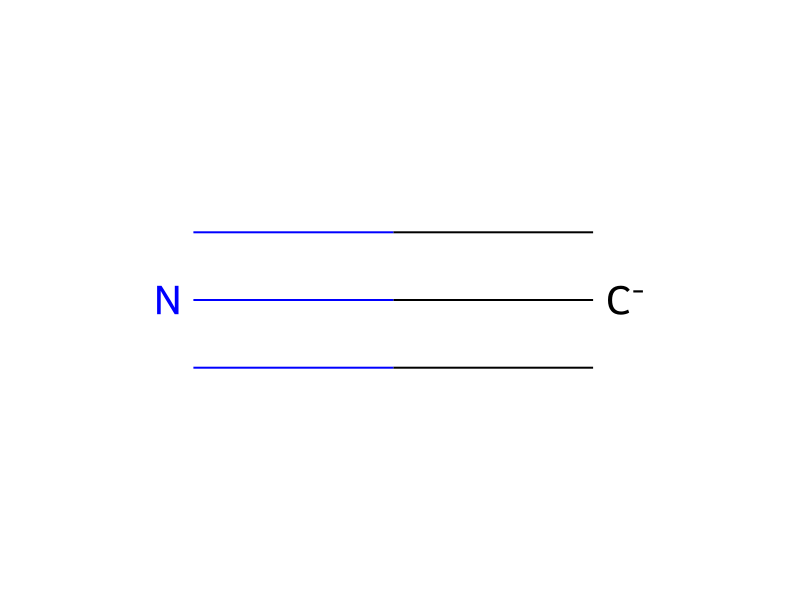
Cyanide → Indole-5-carbonitrile, 3-(2-dimethylaminoethyl)-
Reaction equation

Br[C:2]1[CH:3]=[C:4]2[C:8](=[CH:9][CH:10]=1)[NH:7][CH:6]=[C:5]2[CH2:11][CH2:12][N:13]([CH3:15])[CH3:14].[C-]#N.[CH3:18][N:19](C=O)C>C1(P([C-]2C=CC=C2)C2C=CC=CC=2)C=CC=CC=1.[C-]1(P(C2C=CC=CC=2)C2C=CC=CC=2)C=CC=C1.[Fe+2].C1COCC1>[CH3:14][N:13]([CH3:15])[CH2:12][CH2:11][C:5]1[C:4]2[C:8](=[CH:9][CH:10]=[C:2]([C:18]#[N:19])[CH:3]=2)[NH:7][CH:6]=1Participants




Conditions
- Temperature
- 110 °C
Procedure
Under an inert atmosphere a flask is charged with [2-(5-bromo-1H-indol-3-yl)ethyl]-dimethyl-amine (Example 3) (1.0 g, 3.74 mmol), zink cyanide (0.235 g, 2 mmol), Pd2(dba)3xCHCl3 (0.194 mg, 5 mol %), dppf (bis-diphenylphosphino ferrocene) (0.207 g, 0.374 mmol, 10 mol %), and DMF (12 mL). The orange slurry is heated to 110° C. and stirred for 21 hours. To the black suspension which has formed, THF (100 mL) is added, and this is extracted with 1 N NaOH (100 mL). The organic layer is washed with water twice (50 mL each), dried and removal of the solvent gives the title product (0.67 g, 84%) as brown solid. 1H-NMR (CDCl3, 300 MHz) δ 2.35 (s, 6H, 2 CH3); 2.67 (m, 2H, CH2NMe2); 2.91 (m, 2H, CH2); 7.01 (s, 1H, H-2); 7.13 (d, 1H, 3J=8.3 Hz, H-7); 7.26 (dd, 1H, 4J=1.6 Hz, H-6); 7.87 (d, 1H, H-4); 9.80 (br s, 1H, NH). 13C-NMR (CDCl3, 75 MHz) δ 23.48 (CH2); 45.42 (CH3); 60.06 (CH2N); 101.75 (C-5); 112.24 (C-7); 114.74 (C-3); 121.41 (CN); 124.49 (C-4); 124.62 (C-6); 124.75 (C-2); 127.31 (C-9); 138.47 (C-8).
Workup
- customTo the black suspension which has formed
- extractionthis is extracted with 1 N NaOH (100 mL)
- washThe organic layer is washed with water twice (50 mL each)
- customdried
- customremoval of the solvent
Sources & evidence
- ORD record
- ord-f7d99c06f3394f8b8d8c1e90c547dc45
- Source dataset
- uspto-grants-2010_01
- Patent number
- US07645886B2
Reaction notes
Loading…