Cyclopropanecarbonyl chloride → N-(7-(cyclopropylamino)-3-formylpyrazolo[1,5-a]pyrimidin-5-yl)cyclopropanecarboxamide
Reaction equation

[NH2:1][C:2]1[CH:7]=[C:6]([NH:8][CH:9]2[CH2:11][CH2:10]2)[N:5]2[N:12]=[CH:13][C:14]([CH:15]=[O:16])=[C:4]2[N:3]=1.[CH:17]1([C:20](Cl)=[O:21])[CH2:19][CH2:18]1.CCN(C(C)C)C(C)C>O1CCCC1>[CH:9]1([NH:8][C:6]2[N:5]3[N:12]=[CH:13][C:14]([CH:15]=[O:16])=[C:4]3[N:3]=[C:2]([NH:1][C:20]([CH:17]3[CH2:19][CH2:18]3)=[O:21])[CH:7]=2)[CH2:11][CH2:10]1Participants
5
Reactant 3
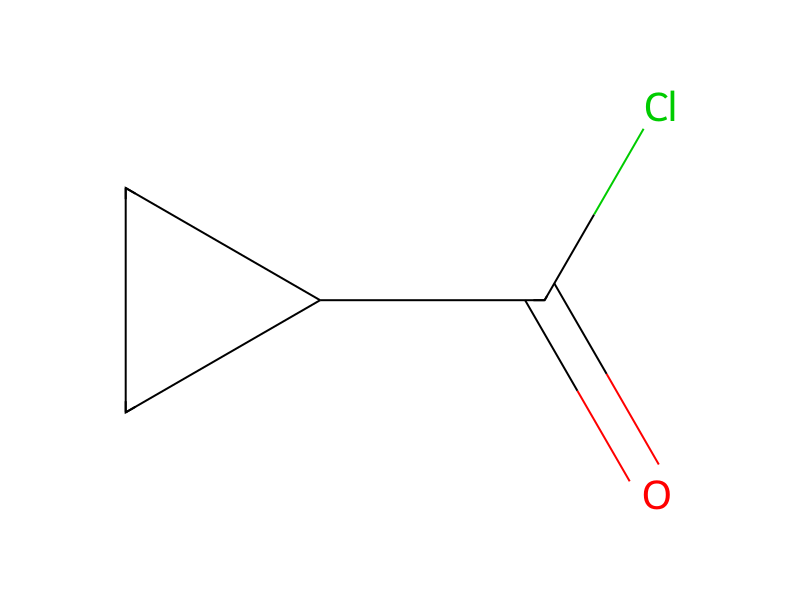


Product 1

Reagents, catalysts & solvents 1

Conditions
- Temperature
- 60 °C
Procedure
To 5-amino-7-(cyclopropylamino)pyrazolo[1,5-a]pyrimidine-3-carbaldehyde (step b) (58 mg, 0.266 mmol) in 1.0 mL tetrahydrofuran was added cyclopropane carbonyl chloride (38 ul, 0.419 mmol) and DIPEA (39.0 ul). The reaction mixture was heated at 60° C. for one hour. The reaction was partitioned between ethyl acetate and water, the organic layer was dried under sodium sulfate concentrated on high vac to yield N-(7-(cyclopropylamino)-3-formylpyrazolo[1,5-a]pyrimidin-5-yl)cyclopropanecarboxamide. The crude product was taken to next step without further purification. LCMS (M+1=286)
Workup
- customThe reaction was partitioned between ethyl acetate and water
- customthe organic layer was dried under sodium sulfate
- concentrationconcentrated on high vac
Sources & evidence
- ORD record
- ord-7fc34ce7c2984d26aff3b70ebfb5d726
- Source dataset
- uspto-grants-2013_11
- Patent number
- US08575177B2
Reaction notes
Loading…