Hydrochloric Acid → 2-Bromo-4-chloro-6-fluorobenzaldehyde
Reaction equation

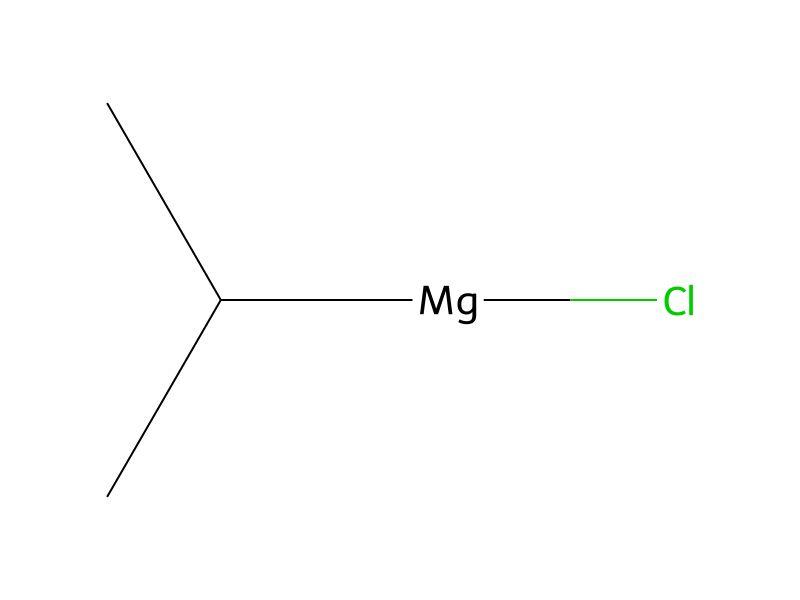
[Br:1][C:2]1[CH:7]=[C:6]([Cl:8])[CH:5]=[C:4]([F:9])[C:3]=1Br.C([Mg]Cl)(C)C.CN([CH:19]=[O:20])C.Cl>CCCCCCC.CCOCC.C1COCC1>[Br:1][C:2]1[CH:7]=[C:6]([Cl:8])[CH:5]=[C:4]([F:9])[C:3]=1[CH:19]=[O:20]Participants
Reactant 4



Product 1

Reagents, catalysts & solvents 3



Conditions
- Temperature
- -45 °C
Procedure
To a solution of 1,2-dibromo-5-chloro-3-fluoro-benzene (10 g, 34.68 mmol) in heptane (27 ml) was added THF (44 ml) and the mixture was cooled to −45° C. Then, iPrMgCl (38.14 ml, 38.14 mmol, 1M solution in THF) was added dropwise to the reaction mixture maintaining the temperature between −40° C. to −45° C. The mixture was stirred for 30 minutes at −40° C. before DMF (13.4 ml, 173.4 mmol) was added dropwise to the reaction mixture maintaining the temperature between −45° C. to −20° C. After stirring for another 15 minutes at −20° C., it was poured into a mixture of 2N HCl (20 ml) and ether (50 ml) at 0° C. The organic layer was separated and the aqueous layer was extracted two times with ether. The combined organic layers were dried with Na2SO4 and evaporated in vacuo to obtain the title compound (7.8 g, 95%) as yellow solid.
Workup
- temperaturemaintaining the temperature between −40° C. to −45° C
- additionwas added dropwise to the reaction mixture
- temperaturemaintaining the temperature between −45° C. to −20° C
- customThe organic layer was separated
- extractionthe aqueous layer was extracted two times with ether
- dry with materialThe combined organic layers were dried with Na2SO4
- customevaporated in vacuo
Sources & evidence
- ORD record
- ord-f496cd856d03468593c266f5a3bbcd92
- Source dataset
- uspto-grants-2013_11
- Patent number
- US08592426B2
Reaction notes
Loading…