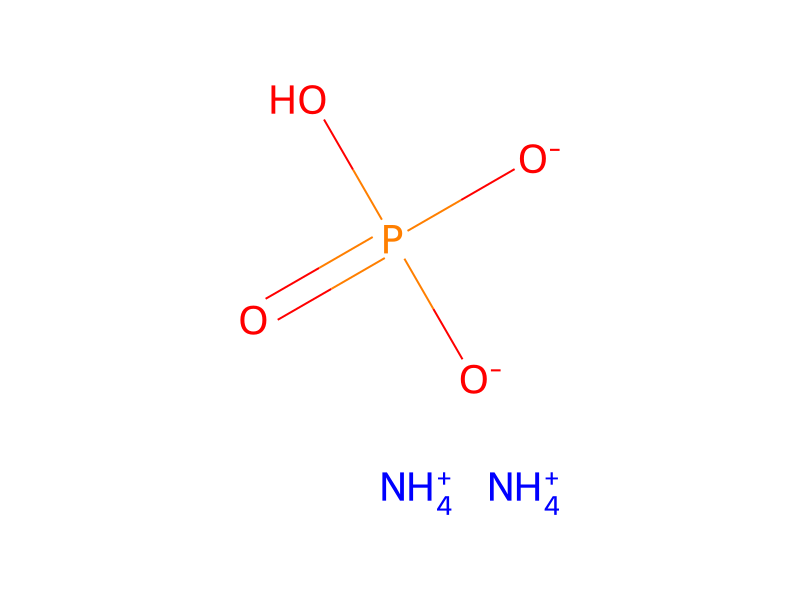
Diammonium hydrogen phosphate → Tricalcium Phosphate
Reaction equation

[N+]([O-])([O-])=O.[Ca+2:5].[N+]([O-])([O-])=O.[P:10]([O-:14])([O-:13])([OH:12])=[O:11].[NH4+].[NH4+]>>[P:10]([O-:14])([O-:13])([O-:12])=[O:11].[Ca+2:5].[P:10]([O-:14])([O-:13])([O-:12])=[O:11].[Ca+2:5].[Ca+2:5]Participants


Procedure
First, calcium nitrate and diammonium hydrogen phosphate in a molar ratio of about 1.2-1.5 to 1 are interacted in aqueous solution at a pH of about 10-12 to produce a gelatinous precipitate of calcium phosphate. Temperature is not critical and the precipitation can be carried out from about 0° C. to 100° C., but is preferably carried out at about room temperature. The gelatinous precipitate thus obtained is separated from the solution by suitable means, for example by centrifugation and decantation of the supernatant. The residual mineral sludge can be washed free of any remaining soluble salts by suspending in distilled water, centrifuging and decanting the supernatant. Although not essential to the process, the latter step appears to minimize cracking during subsequent sintering. The residual product can then be suspended in a minimum amount of distilled water and stored for future use. Conversion to crystalline whitlockite is effected by first homogeneously suspending the mineral sludge in 1 to 3 percent (w/w) aqueous ammonium sulfate. Ordinarily, 10 to 20 ml. of 1 to 3 percent (w/w) aqueous ammonium sulfate per gram of theoretically expected whitlockite ceramic is employed. The solid is then separated from the solution by centrifugation and vacuum filtration. The gelatinous product thus collected contains a large amount of occluded water, much of which can be removed by pressing. The resulting wet clay-like material is cut or shaped into a convenient form or, alternatively cast in a suitable mold. A shrinkage of approximately 25 percent occurs when the wet product is dried and a further shrinkage of about 25 percent takes place during the sintering hereinafter described, and this should of course, be taken into account when shaping or molding the material. The wet product is slowly heated up to the sintering temperature of 1000° C. to 1350° C. at which point all remaining water will have been driven off. Maintaining the temperature at 1000° C. to 1350° C. for approximately 0.5 to 4 hours will then effect the sintering and substantially maximum densification of the product. Ordinarily, it is convenient to isolate the dried product prior to sintering. Thus, the wet product is dried at about 90° C. to 900° C. for approximately 3 to 24 hours or until the water content thereof has been reduced to about 6 percent. It is generally preferred to use drying conditions of approximately 90° C. to 95° C. for about 15 hours or until the water content has been reduced to about 6 percent. The whitlockite obtained in this manner is brittle and porous, but has considerable mechanical strength. Some separation or cracking of the clay-like material may occur on drying especially if a thick filter cake is used. Separation or cracking during drying can be minimized or prevented by adding to the suspension of freshly precipitated calcium phosphate small amounts of conventional binders known in the ceramics art such as polyethylene glycol or polyvinyl alcohol.
Sources & evidence
- ORD record
- ord-bbbee60275904295bc11fda37bf01aa6
- Source dataset
- uspto-grants-1980_04
- Patent number
- US04195366
Reaction notes
Loading…