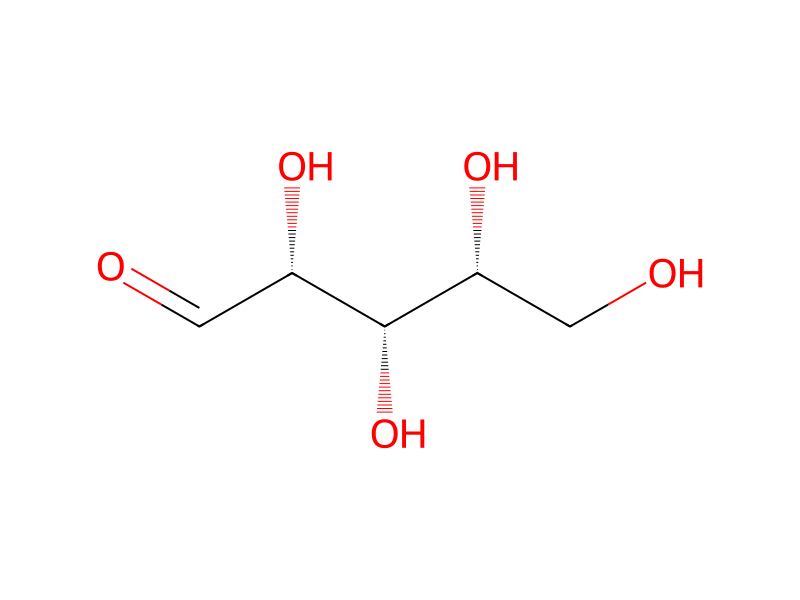
D-Arabinose → Lyxose
Reaction equation

[O:1]=[CH:2][C@H:3]([C@@H:5]([C@@H:7]([CH2:9][OH:10])[OH:8])[OH:6])[OH:4].[O:11]=[CH:12][C@@H:13]([C@@H:15]([C@@H:17]([CH2:19][OH:20])[OH:18])[OH:16])[OH:14]>CO.O>[O:1]=[CH:2][C@@H:3]([C@@H:5]([C@@H:7]([CH2:9][OH:10])[OH:8])[OH:6])[OH:4].[O:11]=[CH:12][C@H:13]([C@H:15]([C@@H:17]([CH2:19][OH:20])[OH:18])[OH:16])[OH:14].[O:1]=[CH:2][C@@H:3]([C@H:5]([C@@H:7]([CH2:9][OH:10])[OH:8])[OH:6])[OH:4]Participants
6
Reactant 2


Product 3

Reagents, catalysts & solvents 1

Procedure
By means of this process it is possible for example to epimerize an approximately 35% strength by weight solution of arabinose in 1:1 methanol/water to D-ribose with a conversion of 35% and a ribose selectivity of 91% without forming detectable amounts of D-lyxose or xylose. The sugar loss is only about 3%. The product solution thus obtained has only a slight yellow color. It can be concentrated to a dry substance content of about 70% to crystallize the bulk of the unconverted arabinose in at least 99% purity, which can be recycled into the epimerization.
Sources & evidence
- ORD record
- ord-360c0bf4032548d69096ceb1f6d8b8b3
- Source dataset
- uspto-grants-1991_05
- Patent number
- US05015296
Reaction notes
Loading…