Dimethylformamide → Methyl 2-fluoro-4-phenylbenzoate
Reaction equation

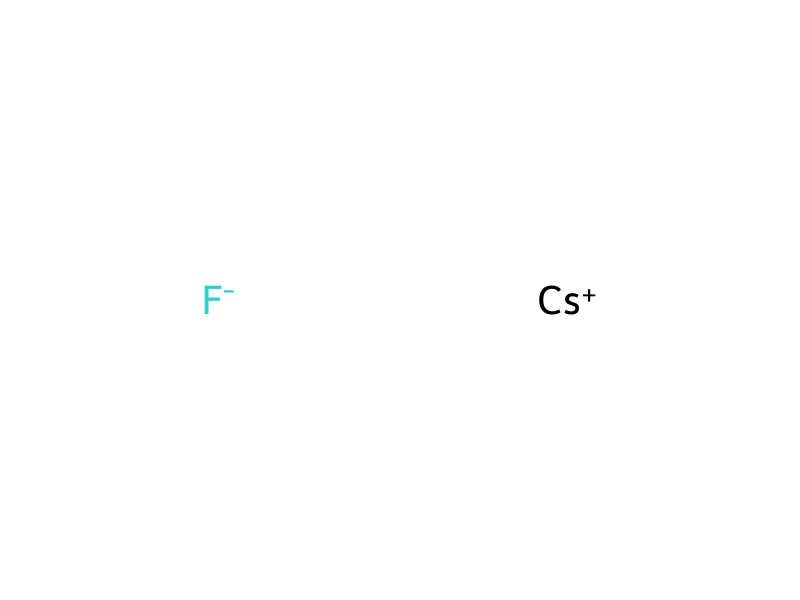
Br[C:2]1[CH:11]=[CH:10][C:5]([C:6]([O:8][CH3:9])=[O:7])=[C:4]([F:12])[CH:3]=1.[C:13]1(B(O)O)[CH:18]=[CH:17][CH:16]=[CH:15][CH:14]=1.[F-].[Cs+].CN(C=O)C>CC([O-])=O.CC([O-])=O.[Pd+2].O>[F:12][C:4]1[CH:3]=[C:2]([C:13]2[CH:18]=[CH:17][CH:16]=[CH:15][CH:14]=2)[CH:11]=[CH:10][C:5]=1[C:6]([O:8][CH3:9])=[O:7]Participants
Reactant 4



Product 1

Reagents, catalysts & solvents 2


Conditions
- Temperature
- 80 °C
Procedure
Combine methyl 4-bromo-2-fluorobenzoate (9.3 g, 40.0 mmol), phenylboronic acid (9.75 g, 80.0 mmol), and cesium fluoride (32.6 g, 100.1 mmol), DMF (190 mL) and deionized water (50 mL). Heat to 80° C. and add Pd(OAc)2 (303 g, 4.0 mmol). After 20 min, cool to room temperature, filter through HyFlo with the aid of 100 mL ethyl acetate, extract the filtrate with 2×100 mL 5% aqueous lithium chloride, 2×50 mL 1.0 M aqueous sodium hydroxide, and 2×100 mL brine. Separate the organic phase, dry over MgSO4, filter, and evaporate in vacuo to yield 8.85 g (96%) of methyl 3-fluorobiphenyl-4-carboxylate as a white solid. 1H NMR (CDCl3, 300 MHz) 8.01 (t, J=7.8 Hz, 1H), 7.58-7.62 (m, 2H), 7.41-7.51 (m, 4H), 7.37 (m, 1H), 3.96 (s, 3H); IR (cm−1, KBr): 3033, 2954, 1721, 1622, 1437, 1409, 1298, 1289, 1266, 1097; Anal calc'd for C14H11FO2: C 73.03, H 4.82; Found: C 73.06, H 4.86.
Workup
- temperaturecool to room temperature
- filtrationfilter through HyFlo with the aid of 100 mL ethyl acetate
- extractionextract the filtrate with 2×100 mL 5% aqueous lithium chloride, 2×50 mL 1.0 M aqueous sodium hydroxide, and 2×100 mL brine
- customSeparate the organic phase
- dry with materialdry over MgSO4
- filtrationfilter
- customevaporate in vacuo
Sources & evidence
- ORD record
- ord-c5de930253ce492c831c3c2dd77ecb7c
- Source dataset
- uspto-grants-2008_02
- Patent number
- US07326731B2
Reaction notes
Loading…