Water → N-(3-bromopropyl)-2,2-diphenylacetamide
Reaction equation

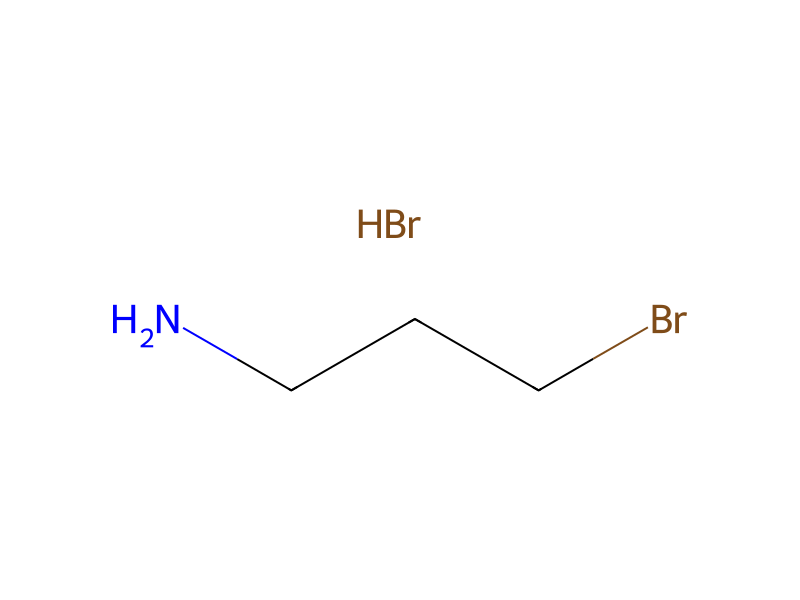
[C:1]1([CH:7]([C:11]2[CH:16]=[CH:15][CH:14]=[CH:13][CH:12]=2)[C:8](Cl)=[O:9])[CH:6]=[CH:5][CH:4]=[CH:3][CH:2]=1.Br.[Br:18][CH2:19][CH2:20][CH2:21][NH2:22].C(N(CC)CC)C.O>ClCCl>[Br:18][CH2:19][CH2:20][CH2:21][NH:22][C:8](=[O:9])[CH:7]([C:11]1[CH:16]=[CH:15][CH:14]=[CH:13][CH:12]=1)[C:1]1[CH:6]=[CH:5][CH:4]=[CH:3][CH:2]=1Participants
6





Conditions
- Temperature
- 25 °C
Procedure
A mixture of 2,2-diphenylacetic chloride (6.00 g, 26.0 mmol), 3-bromo-1-aminopropane hydrobromide (5.69 g, 26.0 mmol) and triethylamine (10.9 mL, 78.0 mmol) in dichloromethane (100 mL) was stirred at 25° C. for 24 hours. Water (100 mL) was added into the reaction mixture and the aqueous layer was extracted with dichloromethane (3×100 mL). The combined organic extracts were washed with brine, dried over MgSO4 and concentrated under reduced pressure. The crude product was chromatographed (Hexanes:EtOAc 2:1) to afford the desired product (6.67 g, 77.5%). 1H NMR (400 MHz, CDCl3) δ δ 7.30-7.17 (m, 10H), 6.64-6.55 (m, 1H), 4.86 (s, 1H), 3.29-3.19 (m, 4H), 1.95-1.85 (m, 2H); ESMS m/e: 332.21 (M+H)+.
Workup
- extractionthe aqueous layer was extracted with dichloromethane (3×100 mL)
- washThe combined organic extracts were washed with brine
- dry with materialdried over MgSO4
- concentrationconcentrated under reduced pressure
- customThe crude product was chromatographed (Hexanes:EtOAc 2:1)
Sources & evidence
- ORD record
- ord-dce072d9aeb440a49767e9e005e7213d
- Source dataset
- uspto-grants-2008_02
- Patent number
- US07335665B2
Reaction notes
Loading…