Water → 2-(2,3-Dihydro-1H-indol-3-yl)ethan-1-amine
Reaction equation

[NH:1]1[C:9]2[C:4](=[CH:5][CH:6]=[CH:7][CH:8]=2)[C:3]([CH2:10][CH2:11][NH2:12])=[CH:2]1.B.C1COCC1.O>FC(F)(F)C(O)=O.O1CCCC1>[NH:1]1[C:9]2[C:4](=[CH:5][CH:6]=[CH:7][CH:8]=2)[CH:3]([CH2:10][CH2:11][NH2:12])[CH2:2]1Participants
Reactant 3

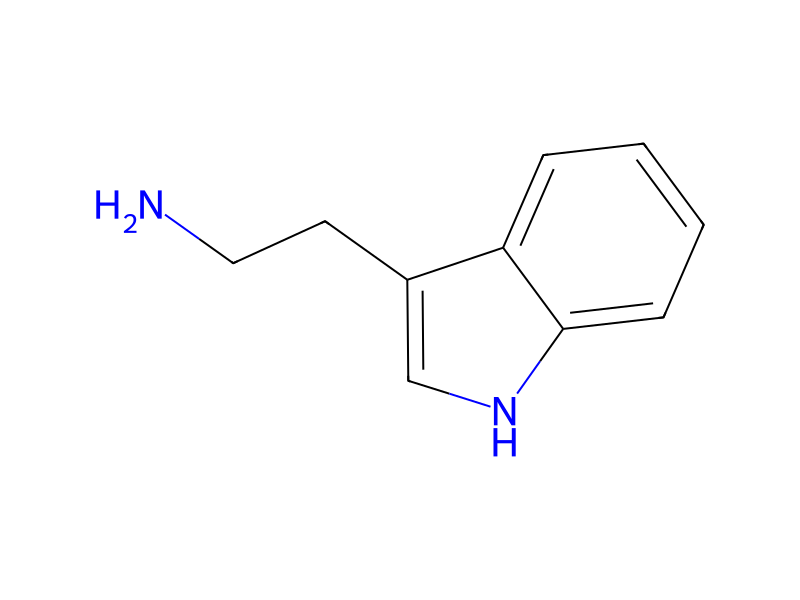

Product 1

Reagents, catalysts & solvents 2


Procedure
2-(3-Indolyl)ethylamine in an amount of 9.4 grams (58.8 millimoles) was dissolved in 120 milliliters of trifluoroacetic acid under nitrogen. The solution was cooled in an ice bath and 100 milliliters of about 1 M BH3.THF in tetrahydrofuran solution was added slowly over about 30 minutes. Thereafter, water (50 milliliters) was added, the resulting solution stirred at room temperature for about 75 minutes, and then evaporated in vacuo to about 40 milliliters of a semi-solid viscous oil. The oil was partitioned between methylene chloride and aqueous sodium hydroxide solution (pH>10). The organic layer was dried over potassium carbonate, filtered and evaporated in vacuo to obtain 8.6 grams of a yellow oily 2-(3-indolinyl)ethylamine product of 98 percent purity (by gas layer chromatographic analysis) in a 90 percent isolated yield. NMR was appropriate for the compound. The HCl salt of 2-(3-indolinyl)ethylamine had a melting point of 186°-188° C.
Workup
- temperatureThe solution was cooled in an ice bath
- customevaporated in vacuo to about 40 milliliters of a semi-solid viscous oil
- customThe oil was partitioned between methylene chloride and aqueous sodium hydroxide solution (pH>10)
- dry with materialThe organic layer was dried over potassium carbonate
- filtrationfiltered
- customevaporated in vacuo
Sources & evidence
- ORD record
- ord-a3a27e4f03304bd283980f4e4e073c16
- Source dataset
- uspto-grants-1980_07
- Patent number
- US04210590
Reaction notes
Loading…