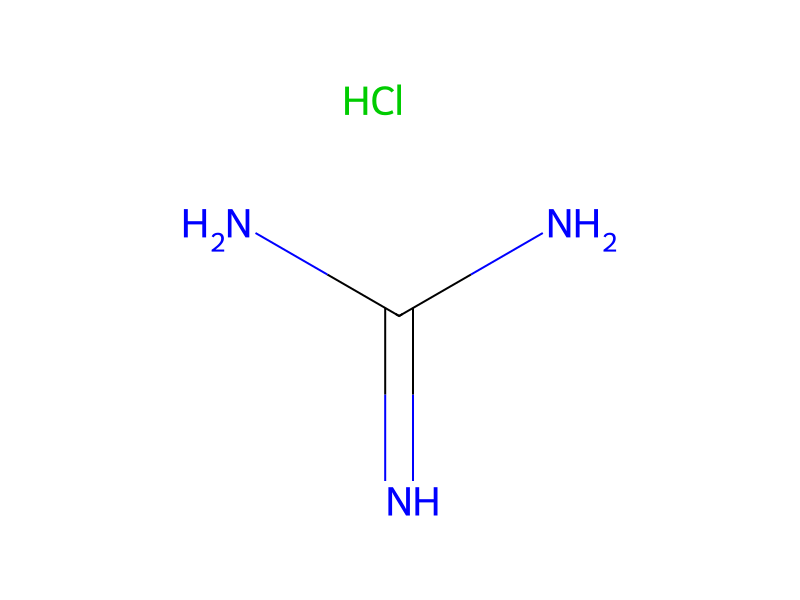
Guanidine Hydrochloride → HCID 178508867, compound
Reaction equation

O=[C:2]1[CH:11]([C:12]([O:14]C)=O)[CH2:10][CH2:9][CH2:8][C:3]21[CH2:7][CH2:6][CH2:5][CH2:4]2.Cl.[NH2:17][C:18]([NH2:20])=[NH:19].C([O-])([O-])=O.[K+].[K+]>CN(C=O)C>[NH2:20][C:18]1[N:19]=[C:12]([OH:14])[C:11]2[CH2:10][CH2:9][CH2:8][C:3]3([CH2:7][CH2:6][CH2:5][CH2:4]3)[C:2]=2[N:17]=1Participants
5
Reactant 3


Product 1

Reagents, catalysts & solvents 1

Procedure
A solution of Example 1B (4.5 g, 21.4 mmol), guanidine hydrochloride (6.13 g, 64.2 mmol), and K2CO3 (9.46 g, 68.5 mmol) in DMF (30 mL) was heated at 105-110° C. for 3 hours. The mixture was then filtered through a layer of diatomaceous earth, and the filter pad was washed with a small amount of DMF. Approximately two volumes of water were then added, and the pH of the resulting mixture was adjusted to pH 6-7 with HOAc. The precipitate was collected, washed with H2O, and dried under vacuum to provide the title product. 1H NMR (300 MHz, DMSO-d6) δ 10.50-10.61 (m, 1 H), 5.98-6.08 (m, 2 H), 2.20 (t, 2 H), 1.95-2.04 (m, 2 H), 1.68-1.76 (m, 2 H), 1.61-1.68 (m, 2 H), 1.48-1.58 (m, 4 H), 1.34-1.45 (m, 2 H). MS (DCI+) m/z 220 (M+H).
Workup
- filtrationThe mixture was then filtered through a layer of diatomaceous earth
- washthe filter pad was washed with a small amount of DMF
- additionApproximately two volumes of water were then added
- customThe precipitate was collected
- washwashed with H2O
- customdried under vacuum
Sources & evidence
- ORD record
- ord-a2707971b8fc4ffc83816ed48e7e7c9c
- Source dataset
- uspto-grants-2012_10
- Patent number
- US08278313B2
Reaction notes
Loading…