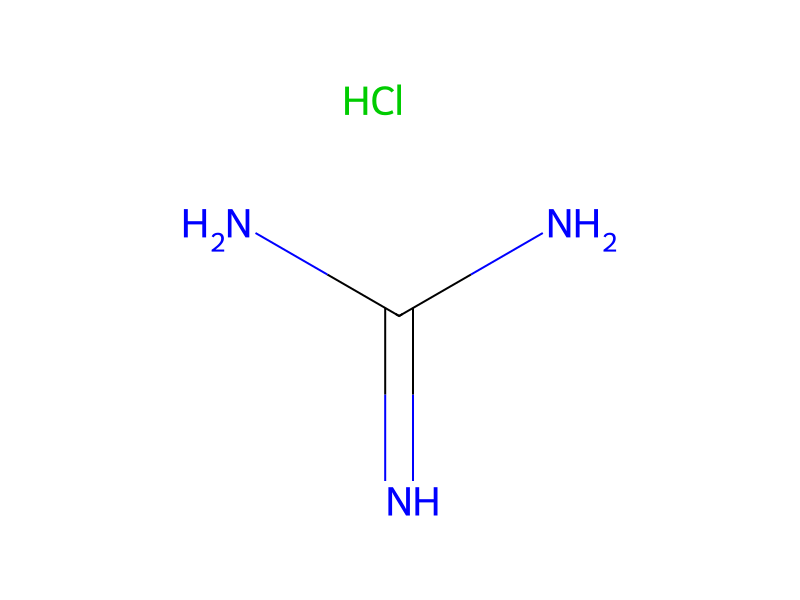
Guanidine Hydrochloride → HCID 178508871, compound
Reaction equation

Cl.[NH2:2][C:3]([NH2:5])=[NH:4].O=[C:7]1[CH:18]([C:19](OC)=[O:20])[CH2:17][CH2:16][CH2:15][CH2:14][C:8]21[CH2:13][CH2:12][CH2:11][CH2:10][CH2:9]2.C(=O)([O-])[O-].[K+].[K+]>CN(C=O)C>[NH2:4][C:3]1[N:5]=[C:19]([OH:20])[C:18]2[CH2:17][CH2:16][CH2:15][CH2:14][C:8]3([CH2:13][CH2:12][CH2:11][CH2:10][CH2:9]3)[C:7]=2[N:2]=1Participants
Reactant 3


Product 1

Reagents, catalysts & solvents 1

Conditions
- Temperature
- 120 °C
Procedure
A mixture of guanidine hydrochloride (430 mg, 4.5 mmol), the product from Example 16B (430 mg, 1.8 mmol), and potassium carbonate (623 mg, 4.5 mmol) in DMF (8 mL) was heated at 100° C. for 16 hours. Then, the temperature was raised to 120° C. for 2 hours. The mixture was cooled to ambient temperature and filtered through a layer of diatomaceous earth, then the filter pad was washed with a small amount of DMF. The filtrate was concentrated under reduced pressure, and the residue was chromatographed on silica gel (10:45:45 MeOH/CH2Cl2/EtOAc, eluant) to provide the title compound as a white solid. 1H NMR (300 MHz, DMSO-d6) ppm 10.62 (s, 1 H), 6.04 (s, 2 H), 2.57-2.64 (m, 2 H), 1.93-2.05 (m, 2 H), 1.60-1.71 (m, 4 H), 1.35-1.57 (m, 9 H), 1.15-1.28 (m, 1 H). MS (DCI+) m/z 248 (M+H).
Workup
- temperatureThe mixture was cooled to ambient temperature
- filtrationfiltered through a layer of diatomaceous earth
- washthe filter pad was washed with a small amount of DMF
- concentrationThe filtrate was concentrated under reduced pressure
- customthe residue was chromatographed on silica gel (10:45:45 MeOH/CH2Cl2/EtOAc, eluant)
Sources & evidence
- ORD record
- ord-20a112029c3144edba1b63335cd378cf
- Source dataset
- uspto-grants-2012_10
- Patent number
- US08278313B2
Reaction notes
Loading…