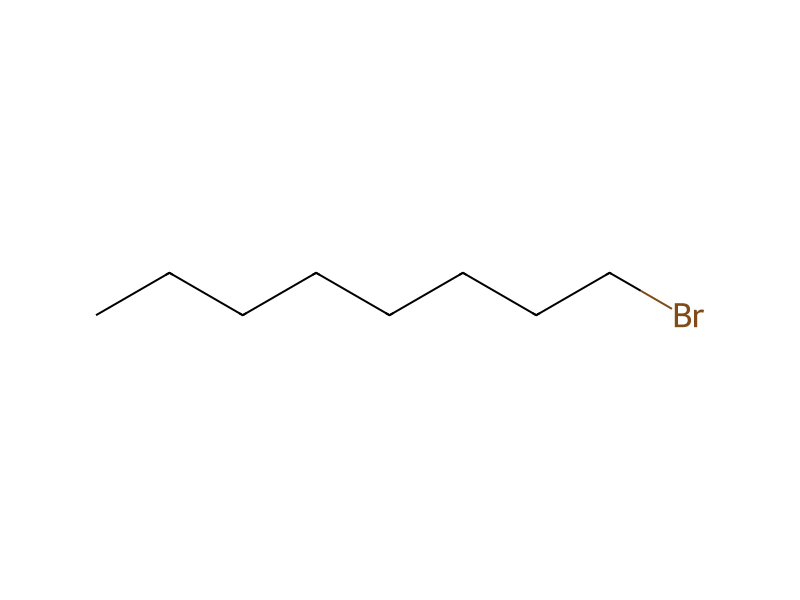
1-Bromooctane → 2,7-Dibromo-9,9-di-n-octylfluorene
Reaction equation

[Br:1][C:2]1[CH:14]=[CH:13][C:12]2[C:11]3[C:6](=[CH:7][C:8]([Br:15])=[CH:9][CH:10]=3)[CH2:5][C:4]=2[CH:3]=1.[H-].[Na+].Br[CH2:19][CH2:20][CH2:21][CH2:22][CH2:23][CH2:24][CH2:25][CH3:26]>C1COCC1>[CH2:19]([C:5]1([CH2:13][CH2:14][CH2:2][CH2:3][CH2:4][CH2:12][CH2:11][CH3:10])[C:4]2[CH:3]=[C:2]([Br:1])[CH:14]=[CH:13][C:12]=2[C:11]2[C:6]1=[CH:7][C:8]([Br:15])=[CH:9][CH:10]=2)[CH2:20][CH2:21][CH2:22][CH2:23][CH2:24][CH2:25][CH3:26]Participants
Reactant 3


Product 1

Reagents, catalysts & solvents 1

Conditions
- Temperature
- 60 °C
Procedure
To a solution of 28.5 g (88 mmol) 2,7-dibromofluorene in 800 mL THF was added 8.8 g (220 mmol) sodium hydride (60%) in several portions at room temperature. The mixture was heated at 60° C. and 43 g (220 mmol) bromooctane in 200 mL THF was added dropwisely into the mixture and refluxed overnight. The mixture was concentrated and diluted with water, and then extracted with diethyl ether. After washing with brine, the ether solution was dried over anhydrous MgSO4 and the ether was then removed by evaporation. This crude solid was purified by a silica chromography with hexane and recrystallized from ethanol to give white solid (36.3 g, yield 75.3%, mp. 52˜54° C.). 1H NMR (500 MHz, CDCl3), δ (ppm): 7.51 (2H, d), 7.44 (2H, d), 7.41 (2H, s), 1.89 (4H, m), 1.02˜1.20 (20H, m), 0.81 (6H, t), 0.56 (4H, m).
Workup
- temperaturerefluxed overnight
- concentrationThe mixture was concentrated
- additiondiluted with water
- extractionextracted with diethyl ether
- washAfter washing with brine
- dry with materialthe ether solution was dried over anhydrous MgSO4
- customthe ether was then removed by evaporation
- customThis crude solid was purified by a silica chromography with hexane
- customrecrystallized from ethanol
Sources & evidence
- ORD record
- ord-47462c7e4b224deaa526d584eab1508f
- Source dataset
- uspto-grants-2012_10
- Patent number
- US08287941B2
Reaction notes
Loading…