Triphenylphosphine → N-(4-Chloro-2-iodo-phenyl)-N-(4-hydroxy-2-methylene-butyl)-methanesulfonamide
Reaction equation

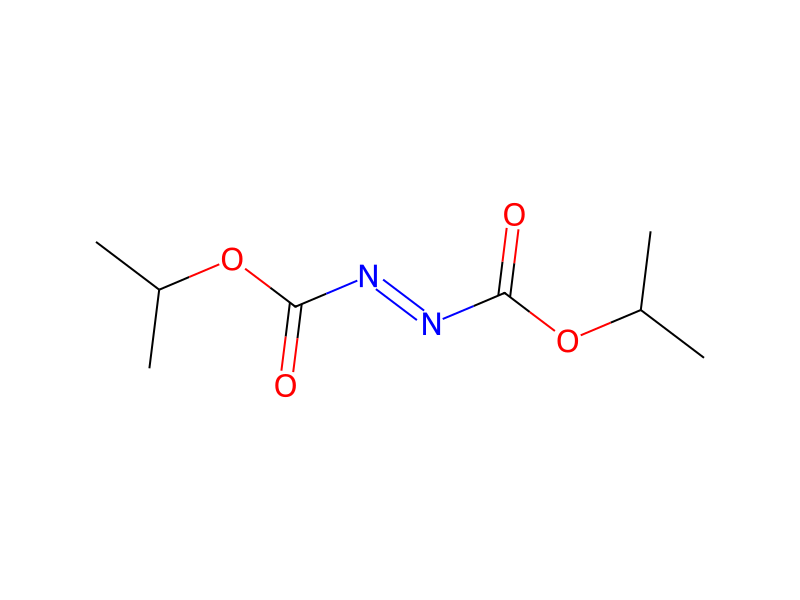
C1(P(C2C=CC=CC=2)C2C=CC=CC=2)C=CC=CC=1.CC(OC(/N=N/C(OC(C)C)=O)=O)C.[Cl:34][C:35]1[CH:45]=[CH:44][C:38]([NH:39][S:40]([CH3:43])(=[O:42])=[O:41])=[C:37]([I:46])[CH:36]=1.[CH2:47]=[C:48]([CH2:51][CH2:52][OH:53])[CH2:49]O>O1CCCC1>[Cl:34][C:35]1[CH:45]=[CH:44][C:38]([N:39]([CH2:49][C:48](=[CH2:47])[CH2:51][CH2:52][OH:53])[S:40]([CH3:43])(=[O:42])=[O:41])=[C:37]([I:46])[CH:36]=1Participants
6
Reactant 4



Product 1

Reagents, catalysts & solvents 1

Conditions
- Temperature
- -10 °C
Procedure
To a stirred solution of triphenylphosphine (2.75 g) in tetrahydrofuran (60 ml) at −10° C. under argon was added dropwise diisopropylazodicarboxylate (DIAD, 2.1 ml); the resulting suspension was stirred at −10° C. for 15 min then 4-chloro-2-iodo-N-methanesulfonyl-aniline (3.1 g) was added as a solid followed by 2-methylene-butane-1,4-diol (0.95 g) dissolved in a minimum of tetrahydrofuran. The reaction mixture was stirred at room temperature for 6 hours, the solvent was evaporated in vacuo and the residue was purified by silica gel chromatography (eluent ethyl acetate:cyclohexane 4:6) to afford N-(4-Chloro-2-iodo-phenyl)-N-(4-hydroxy-2-methylene-butyl)-methanesulfonamide (3.5 g) contaminated with triphenylphosphine oxide.
Workup
- stirringThe reaction mixture was stirred at room temperature for 6 hours
- customthe solvent was evaporated in vacuo
- customthe residue was purified by silica gel chromatography (eluent ethyl acetate:cyclohexane 4:6)
Sources & evidence
- ORD record
- ord-6f39bb89879b45859ecddeb954246c81
- Source dataset
- uspto-grants-2012_10
- Patent number
- US08299058B2
Reaction notes
Loading…