Hydrochloric Acid → 1-Methyl-4-(6-nitropyridin-3-yl)piperazine
Reaction equation

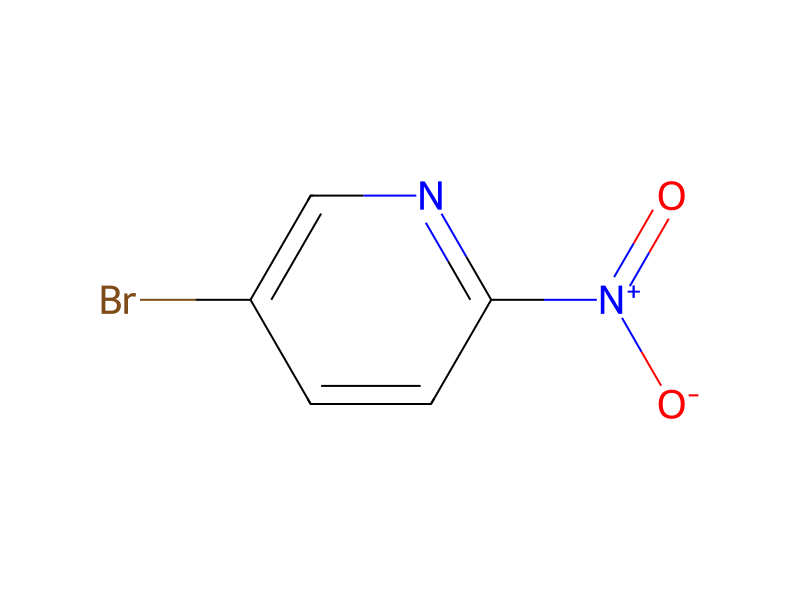
Br[C:2]1[CH:3]=[CH:4][C:5]([N+:8]([O-:10])=[O:9])=[N:6][CH:7]=1.C(=O)([O-])[O-].[K+].[K+].[CH3:17][N:18]1[CH2:23][CH2:22][NH:21][CH2:20][CH2:19]1.Cl>CS(C)=O.[I-].C([N+](CCCC)(CCCC)CCCC)CCC>[CH3:17][N:18]1[CH2:23][CH2:22][N:21]([C:2]2[CH:7]=[N:6][C:5]([N+:8]([O-:10])=[O:9])=[CH:4][CH:3]=2)[CH2:20][CH2:19]1Participants
7
Reactant 4



Product 1

Reagents, catalysts & solvents 2


Conditions
- Temperature
- 120 °C
Procedure
To 5-Bromo-2-nitro-pyridine (2.00 g, 9.85 mmol) in 10 mL dimethylsulfoxide was added potassium carbonate (2.72 g, 19.7 mmol), 1-methylpiperazine (1.64 mL, 14.8 mmol), and tetrabutylammonium iodide (36 mg, 0.097 mmol) and was heated at 120° C. for 18 hours. The mixture was made acidic with 1M aq. HCl and was partitioned between dichloromethane and water. The aqueous layer was made basic with 2M aq. sodium carbonate and was extracted with dichloromethane. The organic layer was dried over anhydrous magnesium sulfate, concentrated in vacuo, and was triturated with water to yield 1-Methyl-4-(6-nitro-pyridin-3-yl)-piperazine (1.82 g, 8.19 mmol). MS (ESI) 223.1 (M+H)+.
Workup
- customwas partitioned between dichloromethane and water
- extractionwas extracted with dichloromethane
- dry with materialThe organic layer was dried over anhydrous magnesium sulfate
- concentrationconcentrated in vacuo
- customwas triturated with water
Sources & evidence
- ORD record
- ord-d58cb3004a4a4fc289b7e6ae5500455d
- Source dataset
- uspto-grants-2012_10
- Patent number
- US08299077B2
Reaction notes
Loading…